
The verdict
A capable full-size luxury sedan, strong on technology and held back by efficiency.
The 2025 Genesis G90 gives you a genuine full-size luxury flagship — Nappa leather, massaging seats, acoustic glass, a 15-speaker Bang & Olufsen system, standard all-wheel drive and the complete driver-assistance suite — for $90,950, roughly $10,000 to $20,000 less than an equivalently equipped BMW 7 Series or Mercedes S-Class. The cabin quality and quietness are class-leading, and Genesis backs it with 5-year/60,000-mile bumper-to-bumper coverage plus three years of free maintenance with valet pickup, terms no German rival matches. The costs show up later: 21 MPG combined on premium fuel runs about $3,700 a year, and the car loses roughly $52,000 in five years, the worst depreciation among non-EV Genesis models. Practical shortfalls are real too — 37.8 inches of rear legroom and a 12.0 cu ft trunk with a fixed rear seatback are both small for a car this size and price.
Jump to scoresStrengths
- A genuinely world-class cabin for the money
- One of the quietest, smoothest-riding cars you can buy
- Every safety and parking feature is standard — there is no upsell
What holds it back
- Thirsty in a way that shows up on every tank
- Depreciation is brutal — about $52,000 in five years
- Small trunk, tight back seat — for a 17-foot car
Top alternatives
Cars shoppers cross-shop with the Genesis G90 3.51A-
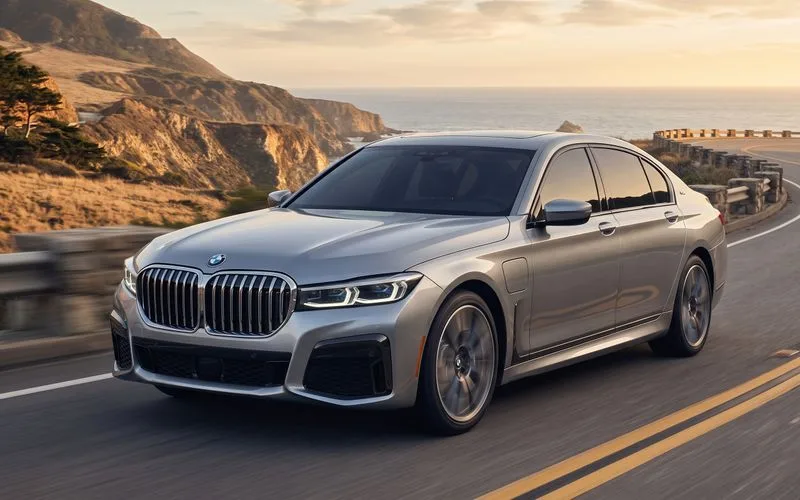 BMW 7 SeriesFull-Size Luxury SedanBetter at: Driving engagement
Costs more once equipped but offers hands-free Highway Assistant, a plug-in 750e and full i7 EV, and a chassis that rewards driving rather than just isolating you from it.
Compare 3.21B+
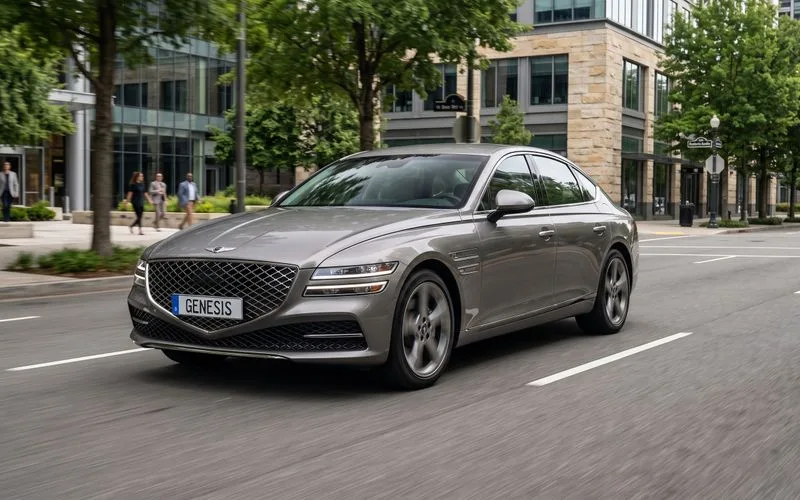 Genesis G80Mid-Size Luxury SedanBetter at: Value
Delivers most of the G90's design, materials and standard-safety story for tens of thousands less, with better resale and newer infotainment including wireless CarPlay.
Compare 3.20B+
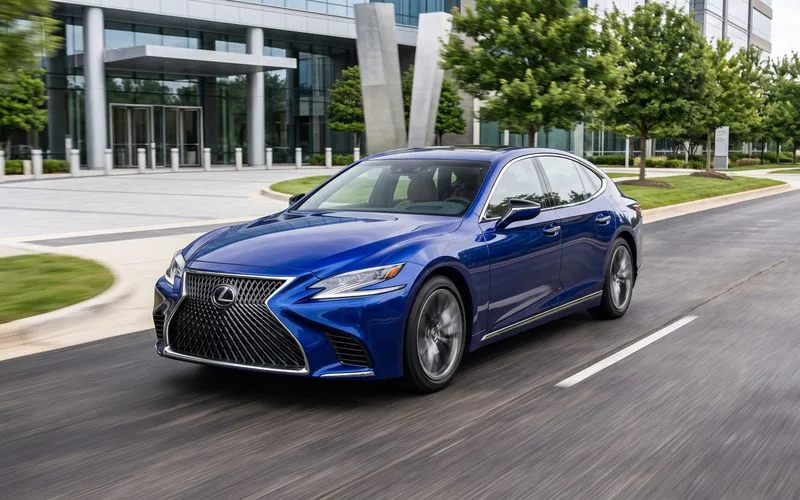 Lexus LSFull-Size Luxury SedanBetter at: Resale value
The safer long-term bet — stronger predicted reliability, roughly 47% five-year value retention against the G90's 37%, and a hybrid powertrain option to cut the fuel bill.
CompareHow it's evolved
10 scored model years · 2017–2026
Subject scores by year
Hover or tap a score to see what moved it versus the year before. A corner mark flags a big swing.
| Year | Performance | Efficiency | Safety | Space | Cost | Reliability | Tech | Use-case | Driving | Value |
|---|---|---|---|---|---|---|---|---|---|---|
| 2026 | 72 | 23 | 78 | 79 | 29 | 78 | 80 | 55 | 72 | 75 |
| 2025 | 71 | 19 | 74 | 73 | 29 | 67 | 80 | 53 | 68 | 74 |
| 2024 | 71 | 19 | 78 | 73 | 29 | 66 | 83 | 53 | 68 | 78 |
| 2023 | 71 | 19 | 79 | 73 | 29 | 63 | 80 | 52 | 68 | 77 |
| 2022 | 71 | 12 | 78 | 77 | 28 | 62 | 62 | 47 | 63 | 63 |
| 2021 | 68 | 13 | 80 | 77 | 28 | 59 | 62 | 47 | 63 | 67 |
| 2020 | 66 | 28 | 80 | 79 | 38 | 62 | 63 | 48 | 62 | 65 |
| 2019 | 66 | 16 | 62 | 80 | 28 | 74 | 55 | 48 | 63 | 66 |
| 2018 | 66 | 16 | 68 | 80 | 40 | 63 | 59 | 47 | 60 | 72 |
| 2017 | 65 | 18 | 68 | 80 | 42 | 66 | 53 | 45 | 64 | 69 |
Compare two years
Best fit & conditions
Higher scores mean a better fit for that use case. Learn more about use-case fit →
Subject profile
Detailed scoring by subject
1Performance & PowertrainGrades above the middle of the scale.2.79B-
The volume 2025 G90 3.5T AWD runs Genesis's Smartstream G3.5 T-GDi twin-turbo V6 at 375 hp, unchanged since the second-generation (RS4) G90 arrived for 2023; 2025 is a carry-over year whose only substantive change is standard wireless CarPlay/Android Auto. The step-up 3.5T E-Supercharger adds a 48-volt mild-hybrid system with an electric supercharger for 409 hp. That base figure exactly matches the 2025 BMW 740i (375 hp, scored 63 here) and clears the Audi A8 55 TFSI (335 hp, 53), while the 3.5T V6 is also the G80's optional engine rather than its volume 2.5T (300 hp, 44).
391 lb-ft arriving at 1,300 rpm is what gives the G90 its effortless part-throttle gait, which is how a car in this class is actually driven. It beats the 2025 740i xDrive (383 lb-ft, 80) and the A8 55 TFSI (369, 75), and is a large step over the G80's volume 2.5T (311, 58).
No outlet appears to have instrumented the non-supercharged 3.5T — every published test of this generation is of the E-Supercharger car, which ran 4.9 s (MotorWeek), 5.1 s (Car and Driver) and 5.4 s (MotorTrend), averaging about 5.1 s. The base trim gives up 34 hp and 14 lb-ft at essentially the same 4,828 lb curb weight, which puts it roughly two tenths behind, near 5.3 s. That is brisk rather than fast and consistent with the car's isolation-first mission: quicker than an A8 55 TFSI (5.6 s, 60), a shade behind a 740i xDrive (4.9 s, 71).
Isolation is the G90's whole argument and the powertrain holds up its end: the twin-turbo V6 is near-silent at cruise, pulls cleanly off a torque plateau that begins at 1,300 rpm, and pairs with standard multi-chamber air suspension and active road-noise cancellation so there is little for engine noise to intrude on. It lands above the A8 (82) and its own G80 sibling (76, whose volume 2.5T four is audibly coarser), but below the 7 Series (90), whose B58 inline-six has a smoothness and sound quality the Genesis V6 does not match when extended. The optional 48V electric supercharger is a genuine engineering answer to turbo lag rather than a marketing one, but it is not on the volume trim being scored.
Genesis pairs the 3.5T with its in-house 8-speed torque-converter automatic with dual shift mode — the same unit and calibration character as the G80, scored 80 here. It is smooth, genuinely unobtrusive at cruise, and picks the right gear without hunting, which is exactly the brief for a full-size luxury sedan. It stays out of the top band because it lacks the outright snap of the ZF 8HP in the 7 Series (92) under hard use, and its paddle-shift manual mode is functional rather than engaging.
HTRAC all-wheel drive is standard on both 2025 US G90 trims rather than an option over a rear-drive baseline, with a rear-biased split that varies by drive mode, and it arrives alongside standard rear-wheel steering. That standard fit places it above the 7 Series (80), which still sells a rear-drive 740i, and level-to-slightly-above its G80 sibling (80, same HTRAC hardware) for the added rear-steer. It stops short of the top because the system is tuned purely for on-road traction — no low range, no terrain modes — as befits the body style, and Audi's long-standing standard quattro (95) still reads as the segment benchmark.
The 2025 US G90 offers one engine in two states of tune: the 3.5L twin-turbo V6, and the same V6 with a 48V electric supercharger and mild-hybrid assist. That is the thinnest slate in the full-size luxury segment — no V8, no plug-in hybrid, and no battery-electric G90 for the US, where the Electrified G90 sold in Korea is not marketed. Against a 7 Series spanning a mild-hybrid six, a 750e PHEV and a full i7 EV (80), or even its own G80 sibling with a 2.5T, a 3.5T and an Electrified G80 BEV (82), the choice on offer is narrow. The 48V variant is real distinct hardware rather than a trim sticker, which is the only thing keeping this off the floor; it lands just below the single-engine A8 (52) only because the A8's variant is a genuinely different V8 in the S8.
2Efficiency & RangeThe G90's lowest-graded category.0.00F
A 4,828 lb full-size sedan with a 3.5L twin-turbo V6 and standard AWD rates 21 MPG combined, near the floor of the gas-sedan band and below every scored peer in the segment — the A8 55 TFSI manages 22 and the 740i xDrive 27. The 48V mild-hybrid E-Supercharger trim is thirstier still at 20 MPG, because its electrification serves performance rather than economy.
City is the G90's worst case: nearly two and a half tons of car with no hybrid drive to cover low-speed running returns 18 MPG, below the 20 MPG posted by both the A8 55 TFSI and the G80's volume 2.5T and well behind the 740i xDrive's 24.
Highway is where the G90 defends itself best — a tall top gear, slippery bodywork and engine stop-start return 26 MPG — but that is only two MPG above the floor of the sedan highway band, so it earns almost nothing against a field containing 50+ MPG hybrids. It ties the A8 55 TFSI exactly and trails the 740i xDrive by five.
Genesis pairs mediocre economy with a comparatively small 19.3-gallon tank for the class, so the G90's cruising leg lands near 405 miles — usable, but a long way behind the A8's ≈477 mi (21.7-gal tank) and the 740i xDrive's ≈526 mi, both of which carry more fuel and burn it more slowly. For a flagship sold on effortless long-distance travel, the tank is the limiting factor rather than the engine.
EPA's own label figure is $3,700 a year — about 714 gallons of premium at the agency's standard assumptions — which is above the top of the sedan band entirely and reads more like a full-size truck's fuel bill than a sedan's. EPA also scores the G90 as costing $7,250 more in fuel than the average new vehicle over five years. It is the most expensive car to fuel among the segment peers scored here: the A8 is $3,450, the 740i xDrive $2,800.
Genesis recommends 91 AKI premium for the G3.5 T-GDi to reach its published output but explicitly permits 87 AKI regular at reduced performance, so a G90 owner has an out that an A8 (premium required, 30) or 7 Series (25) driver does not. It sits a little under its G80 sibling (62) on the same manufacturer policy because every G90 is the thirsty 3.5T rather than the G80's volume 2.5T, so the practical premium-fuel penalty is larger in dollars even though the rule is identical. No E85, diesel or plug-in option exists.
3SafetyOne of the G90's strongest categories.3.05B
NHTSA has never crash-tested any model year of the second-generation (RS4) G90: the 2023, 2024 and 2025 records all return "Not Rated" on every measure, so there is no star rating to carry forward and none to inherit from the current generation either. Large luxury flagships routinely go untested at NHTSA (the Audi A8 is the same story in this dataset), so the value is an estimate from segment norms rather than a measurement — treated the same way the 2025/2026 A8 is (4.5★, 75). Dealer-blog and brand-marketing claims of a "5-star Genesis lineup" do not survive checking against NHTSA's own database and were not used.
The 2025 G90 is an IIHS TOP SAFETY PICK — not TSP+ — and the reason is a single test: updated moderate overlap front comes back Acceptable, because rear passenger restraints and dummy kinematics rate Marginal even after Genesis revised the rear belts twice (October 2023 and again February 2025; both the pre-March-2025 and post-February-2025 builds of the 2025 car rate Acceptable overall, so the whole model year is the same). Everything else is Good: small overlap front driver and passenger, updated side, seat belt reminders. That is squarely "mostly Good with some Acceptable" but with an award in hand, so the top of the middle band — clearly ahead of the 2025 G80 (50 here; its updated moderate overlap is Marginal) and the untested A8 (67), and behind the TSP+ BMW i5 (91).
The G90 sells in exactly two configurations — 3.5T AWD ($90,950) and 3.5T E-Supercharger ($101,350) — and the driver-assistance content is identical on both, so there is no trim at which a safety feature is missing. Standard on the volume car: Forward Collision-Avoidance Assist with pedestrian detection, Smart Cruise Control with stop-and-go, Highway Driving Assist 2 (lane centering plus assisted lane change), Lane Following/Lane Keeping Assist, Blind-Spot Collision-Avoidance Assist with the camera-fed Blind-Spot View Monitor, Rear Cross-Traffic Collision-Avoidance Assist with braking, rear automatic braking, Safe Exit Assist and a 360-degree camera. That is the full AEB/ACC/LKA/BSM/RCTA set standard across the range, which is the 80–100 band; the small reservation is that a nine-figure-content flagship has no room above it, not that anything is optional.
The pedestrian half is excellent and the vehicle-to-vehicle half is merely Acceptable, which is what keeps this out of the top band. In IIHS pedestrian testing the G90 avoided every collision — crossing child at 12 and 25 mph, crossing adult at night at 12 and 25 mph, and parallel adult at night at 25 and 37 mph — on low beams as well as high, earning Good. But under the harder vehicle-to-vehicle 2.0 protocol it only reduces speed rather than stopping at 43 mph (39 and 33 mph of reduction), and hits the motorcycle target at 31 and 43 mph, for an Acceptable overall. Genuinely strong night-pedestrian performance, average closing-speed performance against vehicles.
Standard and active rather than alert-only: Blind-Spot Collision-Avoidance Assist can steer/brake against a lane change into an occupied lane, Rear Cross-Traffic Collision-Avoidance Assist brakes rather than just chiming, and Safe Exit Assist holds the rear doors against traffic approaching from behind — the last of which matters on a car whose owners are often being let out at a curb. The Blind-Spot View Monitor's live side-camera feed in the cluster on turn signal is a real addition to coverage, not a gimmick. Held below the 90s by the one substantive reviewer complaint: the warning lingers after the adjacent car has cleared.
Highway Driving Assist 2 layers lane centering and assisted lane change on top of Lane Following Assist and standard lane departure warning/prevention, all standard. Hyundai/Genesis's centering is among the better hands-on implementations and reviewers describe it holding the middle of the lane through mild curves without the correction-and-recorrection that characterizes weaker systems; on the G90 specifically it also has an unusually quiet, well-damped chassis to work through. Scored at the bottom of the top band rather than higher because the praise comes from general-purpose G90/HDA2 coverage rather than a published instrumented lane-centering comparison of this car.
The hardware and integration are top-band — full-speed-range Smart Cruise Control with stop-and-go, a machine-learning mode that adapts following distance and acceleration to the owner's own driving style, and HDA2 folding steering and assisted lane changes into the same system, standard on both trims. What pulls it back is the calibration: the most detailed 2025 road test found the system too conservative, holding a longer gap than wanted and taking an unusually long time to recover speed once traffic clears. Refined highway assist with real rough edges in the speed loop, which is the honest middle of this item.
No hands-free option exists on the 2025 G90 at any trim or in any package. HDA2 is explicitly a hands-on system — Genesis's own materials instruct the driver to keep hands on the wheel, and the car nags and then disengages if torque is absent. Genesis announced a Level 3 "Highway Driving Pilot" for the G90 in Korea but it has never reached the US market. The small non-zero score reflects that HDA2 is a capable Level 2 system, not that any part of it is hands-free; this is consistent with how the rest of the Genesis line scores here (2024/2025 G80: 15/10) and far behind the BMW i5's Highway Assistant (88).
IIHS rates the G90's LED projectors Acceptable, and that rating applies to all trims across 2023–26 — so there is no better headlight to step up to, which is the one thing that would have pushed this higher. The measured behavior explains the grade: low-beam visibility is fair on the left of a straightaway and inadequate on the right, and inadequate on both left curves, with high-beam assist earning credit for partially compensating. The car has no curve-adaptive function despite being a $91,000 flagship. Acceptable everywhere, with nothing Good and nothing Marginal, is the middle of this item.
Natural sightlines are ordinary for a long-hooded full-size sedan and the deliberately heavy C-pillar — styled that way for rear-seat privacy — leaves a real over-the-shoulder blind zone, which matters more here because the G90 is nearly 17 feet long. The compensation is thorough and standard rather than optional: a high-quality 360-degree surround view, the Blind-Spot View Monitor putting a live side-camera feed in the cluster on turn signal, and a clear head-up display that keeps the driver's eyes up. Average sightlines, good camera coverage — the upper half of the middle band.
Two complete LATCH sets at the rear outboard positions plus a center tether anchor is the ordinary arrangement, and the rear doors on a car this size open wide, so getting a seat through the aperture is easy. Two things keep it out of the top band. Rear legroom is 37.8 inches — not tight in absolute terms but well short of the 42-plus inches this class usually offers, so a rear-facing seat squeezes the front passenger more than the price suggests. And the G90's rear seat is built around reclining, ventilated, massaging thrones with heavily bolstered cushions and a wide center console on the E-Supercharger, which is the opposite of a flat, seat-friendly bench and makes three-across impractical. IIHS publishes no LATCH ease-of-use rating for this car, so the anchor-depth question is unverified.
4Space & ComfortGrades above the middle of the scale.2.94B-
Both 2025 US configurations — the 3.5T and the 3.5T e-Supercharger — are five-passenger standard-wheelbase sedans on a single 125.2 in wheelbase; the long-wheelbase four-seat VIP G90 described in the Wikipedia article is a Korean-market car and is not offered in the US.
39.4 in sits near the top of the 36–40 in sedan band, and because the panoramic sunroof is standard equipment on every US G90 this is the real as-delivered number rather than a no-sunroof best case. Carried over unchanged for 2025 — the RS4 generation's body was not altered.
42.3 in is mid-band for a sedan and unremarkable for a car 207.7 in long — the G90's packaging spends its length on cabin width (59.1 in front shoulder room) and on rear-passenger presentation rather than on front stretch-out room.
38.0 in of second-row headroom is strong within the 35–39 in sedan band — the G90's roofline stays flatter over the rear bench than the fastback-profiled G80's, so six-footers sit without contacting the microfiber suede headliner.
The standard-wheelbase G90's genuine packaging weakness relative to its $90,950 price: 37.8 in is only mid-band, essentially level with the smaller G80 and well short of an S-Class or 7 Series, and US buyers get no long-wheelbase alternative to fix it.
12.0 cu ft is near the bottom of the 10–20 cu ft sedan band and is the G90's most-criticized practical shortcoming. The rear seatback does not fold — only a ski pass-through — so there is no expansion path at all.
Competent rather than inventive: a deep covered console with a standard front wireless charging pad, five USB-C ports, usable door bins and a rear armrest with cupholders and its own controller. The wide console and shifter surround eat open shelf space, the rear wireless charger remains e-Supercharger-only, the rear seatback is fixed, and there is no underfloor bin or onboard AC power — nothing here reaches the innovation band.
One of the G90's clearest strengths — Nappa leather, an 18-way power driver's seat with four massage modes and power bolsters, heated and ventilated front seats and heated rear seats, all standard on the volume 3.5T. Held below 90 because on the volume trim the rear seats are heated only: rear ventilation, rear massage and the rear memory system are e-Supercharger equipment, and 37.8 in of rear legroom caps genuine long-haul back-seat comfort.
The volume 3.5T rides on Electronically Controlled Suspension with Road Preview — a front camera reads the surface ahead and pre-loads the dampers — and reviewers describe the result as supple and unruffled over broken pavement without floating. Scored a notch below the top of the band because the multi-chamber air suspension and rear-wheel steering that sharpen body control are e-Supercharger-only, so the volume car gets the isolation but not the top-tier body discipline.
Among the quietest cars sold in the US, and standard-fit rather than optioned: acoustic laminated glass covers the windshield plus both front and rear side windows, and Active Noise Control is standard on both trims. Placed just below the very top of the band only because no instrumented dB figure was available to confirm it beats an S-Class or LS outright.
Close to a clean sweep on the single base grade: 3-zone climate, heated/ventilated/massaging front seats, heated rear seats, a heated power tilt-and-telescopic wheel, Mood Curator with power rear and rear-side sunshades, an antibacterial package, adjustable ambient lighting, and — new for 2025 — Genesis Connected Services standard, so remote climate pre-conditioning is no longer conditional. Short of a perfect score only because ventilated and massaging rear seats, the amenities a flagship's rear passengers most notice, still require the ~$10,300 step to the e-Supercharger.
5Cost of OwnershipOne of the G90's weakest categories.0.00F
The 2025 G90 opens at $89,700 plus $1,250 destination for the 3.5T AWD, the only entry point in the US lineup — there is no rear-drive or lower-output version to step down to. That is far above the sedan band's $55,000 ceiling, so the item floors at 0; the flagship-sedan price is the point of the car, not a defect, which is why this item carries no weight.
Unusually for the class, the volume-trim price and the base price are the same number: Genesis sells the G90 as two fixed specifications with no option packages at all, so a 3.5T AWD cannot be optioned up and there is no "as typically equipped" premium to add. Scored on the 3.5T AWD to stay consistent with the rest of this scorecard, which grades the 375-hp non-hybrid V6 as the representative configuration; the caveat is that trim-mix data is not published and the thin used-listing pool skews toward the $101,250 E-Supercharger, so the true volume trim could be the dearer car.
The two published estimates disagree by a factor of three and each has an identifiable flaw, so this is a reconciled figure rather than a quoted one. KBB's $8,784 is a flat class model that never credits Genesis's included service — it returns the identical $8,092 maintenance line for the 2026 car — while CarEdge/RepairPal's $2,822 is a class-level inference that RepairPal itself flags as resting on insufficient G90 data. What is real: three years/36,000 miles of scheduled service is free and unusually covers brake pads and alignment, and bumper-to-bumper runs to 5 years/60,000 miles, so a 15,000-mile-a-year owner only starts paying in year four. Against that sit premium dealer labor, a twin-turbo V6, and 20-inch tires, which is what keeps the figure well above the CarEdge number.
Depreciation is the G90's defining ownership cost and the published spread is a difference of basis, not of fact: iSeeCars (47.6%) and CarEdge (47.95%) both measure used retail asking prices against MSRP, while KBB's 37.3% is a projected trade-in/private-party residual, which on a luxury flagship runs well below asking. The 42% used here sits between them, which is roughly what an owner actually realizes on a private sale. Real listings bracket it — a 2021 G90 at five years asks about $37,654 against a ~$74,500 sticker (50.5% on an asking basis, less once negotiated), and the redesigned second-generation car is tracking the same curve rather than escaping it. A thin US luxury badge, a collapsing full-size sedan market, heavy factory discounting from day one and a 10-year powertrain warranty that halves for the second owner all push the same direction.
Five years of bumper-to-bumper coverage tops the segment band and beats every German rival in the class, all of which stop at four years — the BMW 7 Series, Audi A8 and Mercedes S-Class are 4 yr/50,000 mi. It is also a full year longer than the class norm at the point where a complex flagship starts generating electronics claims.
Ten years and 100,000 miles on the engine and transmission is the top of the band and double what the German flagships offer, which fold powertrain into the same 4-year basic term. The asterisk that matters for resale rather than for the first owner: the ten-year term does not transfer — a second owner gets 5 yr/60,000 mi — which is part of why the resale figure above is what it is.
The strongest ownership-perks package in the full-size luxury segment, and the gap over the established rivals is wide: none of Mercedes, BMW or Audi include scheduled maintenance at all on their flagships. Genesis bundles 3 years/36,000 miles of complimentary scheduled service — covering brake pads and wheel alignment, not just oil and filters — with Genesis Service Valet, where a technician collects the car and leaves a loaner, so routine service costs the owner neither money nor a dealer visit. Add 5 years of unlimited-mileage roadside assistance and a 3-year Genesis Connected Services subscription. Held just below the ceiling because the maintenance term is three years rather than the four or five some brands have run, not because anything is missing.
$90,950 volume-trim price minus its estimated resale value after 5 years (42% retained, or about $38,199) leaves about $52,751 in depreciation. Add the projected $5,500 in 5-year maintenance and repairs, and owning this vehicle for 5 years costs about $58,251 in total.
6Reliability & QualityMid-pack among this car's ten categories.2.50C+
As with the 2024 car, neither authority produces a usable model-specific prediction, and that absence is itself the finding: Consumer Reports' 2025 G90 reliability page returns "No Detailed Data Available" because US G90 volume falls short of the 200–400 survey samples CR needs, and jdpower.com refuses automated fetch. (A search-result summary asserting CR expects "about average" reliability for this year was not reproducible on the page itself and is not relied on here.) With no direct owner-survey signal the prediction leans on observables, which are mixed. Against the car: four NHTSA campaigns reach the 2025, two of them safety-critical, and this remains the most feature-dense vehicle Genesis builds — multi-chamber air suspension, rear-wheel steering, active road-noise cancellation, 23-speaker B&O, dual 12.3-inch displays — which is where predicted-reliability scores are lost. For the car: 2025 is the third year of the RS4 generation rather than the second, so the package has had another year to settle, and initial quality held at third among premium brands. Scored two points above the 2024 G90 (60) on that additional settling with otherwise identical exposure, and still well below the segment median (71.5). This must NOT be read as carrying the 2026 G90's 74 backward — that score was written without live grounding and self-identifies as such.
Genesis's two dependability signals point in opposite directions and the long-term one is deteriorating — a brand-level fact, so it is scored identically here and on the 2024 G90 and the 2023/2024/2025 G80. Initial quality is genuinely strong and stable: 184 PP100 and third premium brand in the 2024 IQS, 183 PP100 and third premium in 2025, improving to 151 PP100 and second overall by 2026. But that measures 90 days, and the 2025 result came with only a ninth-place overall finish. On three-year dependability Genesis scored 208 PP100 in the 2026 VDS — third among premium brands, yet below the 204 PP100 industry average and a steep slide from the 144 PP100 that put it second in 2023, meaning the cohort now reaching three years is testing worse than its predecessors. Consumer Reports is harsher still: 21st of 26 brands at 33/100, with no Genesis model rated average-or-better. Top-three on day 90 and below-average at year three is mid-pack across an ownership cycle, not the "consistently top-5" the 80+ tier requires.
The 2025 G90 carries exactly the same four NHTSA campaigns as the 2024 — every one of them is scoped to a range that includes this model year — so the exposure is identical and the score is held level. The severity mix is what puts this below the typical-activity band rather than the raw count. Two are genuinely safety-critical: front seat belt anchors that may detach (a restraint that cannot hold an occupant in a crash, part of a ~300,000-vehicle Hyundai-group campaign) and a fuel leak at the fuel-pipe/fuel-rail connection, a fire-risk defect that maps onto the known high-pressure crossover-pipe weakness of this engine family. The other two are driver-facing electronics: an instrument-panel display software failure that loses the speedometer and warning indicators (an FMVSS 101 non-compliance) and a Highway Drive Assist corner radar that can falsely detect a vehicle and brake the car unintentionally — severe enough that Genesis told owners to stop using HDA until the bumper beam was replaced. Nothing here is a systemic engine or structural defect, which is why this is not lower, but two restraint/fire campaigns plus two electronics campaigns on a low-volume flagship is materially worse than the segment norm. The 24V282000 low-pressure fuel-pump campaign covers 2022–2023 build and does not reach the 2025.
2025 is a carry-over year in the second-generation (RS4) G90, so the volume 3.5T AWD keeps the 3.5L Smartstream twin-turbo V6 (375 hp) with the in-house 8-speed torque-converter automatic and standard HTRAC AWD — no belt-driven compressor, no traction motor, no high-voltage battery in the volume configuration, which is a durability advantage against the complexity this car carries elsewhere. The Smartstream G3.5 family is assessed as a clear improvement on the older Lambda II V6, with no systemic failure mode on record and an estimated ~160,000-mile useful life, but it is not yet a proven high-mileage design: documented concerns are timing-chain wear, overheating and oil-pump reliability, plus the high-pressure crossover fuel-pipe issue behind this model year's fire-risk recall. Scored a point above the 2024 G90 (66) for one additional model year of accumulated fleet service on the same engine with no new systemic fault emerging — not enough to reach the proven-family top band. The $100,000 3.5T e-Supercharger trim adds a 48V electric supercharger and mild-hybrid system (409 hp) with a much shorter track record; it is not the volume trim and is not what is scored here. The 10-year/100,000-mile powertrain warranty backs the risk for an original owner.
The cabin is the strongest thing about this car and the clearest reason it exists, and 2025 changes none of it. The volume 3.5T is not a stripped entry point — Nappa leather, open-pore wood, brushed aluminum, a microsuede headliner, suede-wrapped pillars and power soft-close doors are standard across both trims, so soft-touch coverage continues into the secondary surfaces where German rivals switch to plastic. What makes this class-leading rather than merely competitive is the price anchor: the G90 opens at $89,700 against roughly $121,000 for an S 500 4MATIC, and reviewers still place its materials in the same conversation, with attention to detail explicitly compared to Audi and Mercedes. Held level with the 2024 G90 (92) as the same unchanged cabin, and at the top of the full-size luxury field.
Physical assembly draws essentially no criticism — Edmunds calls fit and finish "impeccable" for this model year as it did the last — and it is supported at the brand level by Genesis holding third among premium brands at 183 PP100 in the 2025 IQS, with the flagship built at lower volume and higher attention than the rest of the range. Two things keep it out of the top band. First, the supporting evidence is brand-level rather than nameplate-specific: the G90 won no J.D. Power segment award in 2025, and Genesis's own newsroom names the G70, G80 and GV80 — never the G90 — as its segment performers. Second, the defects owners actually report are electronic and not trivial: recall 027G's instrument-panel display failure loses the speedometer and warning indicators outright, and the HDA radar campaign was severe enough to warrant a stop-using advisory. In-car electronics is the dominant IQS problem category industry-wide and CR's largest trouble spot for the brand, and the G90 carries more of that content than anything else Genesis builds. Held level with the 2024 G90 (84): the premium-brand IQS rank was unchanged year over year, and the softer ninth-place overall finish in 2025 is offset by the unchanged assembly praise.
Coverage is the weak link, and it is a brand fact rather than a model-year one, so it is scored the same here as on the 2024 G90 and the 2024/2025 G80. Genesis operates roughly 85 dedicated standalone retail facilities in the US — against roughly 240 dedicated Lexus stores and 350–380 Mercedes-Benz and BMW dealerships — with the rest of the lineup sold through 200-plus independent, typically Hyundai-affiliated retailers, so a buyer outside a major metro may have no dedicated Genesis service point nearby. That gap bites hardest exactly here, on a $89,700 flagship cross-shopped against brands with dedicated showrooms and a settled service reputation. The offset is substantial and standard rather than optional: every new Genesis includes complimentary Service Valet for 3 years/36,000 miles, which collects the car, performs scheduled maintenance or warranty work, and returns it with a loaner — removing most of the density penalty for owners inside the valet radius, and a 2025 car bought new is still inside that window. Network growth is real but recent, so the footprint disadvantage remains the current condition.
Running costs are low by full-size-luxury standards because the mechanical hardware is shared across the Hyundai group: CarEdge projects about $564 a year — roughly $2,820 over five years — in maintenance and repairs, against roughly $990 in first-post-warranty-year repairs for an S-Class, and RepairPal puts Genesis brand average annual maintenance at $524. Three years/36,000 miles of complimentary scheduled maintenance and the 10-year/100,000-mile powertrain warranty defer most early spending. What caps this well below the G80 (77) is how little of the G90 is shared: the multi-chamber air suspension, rear-wheel-steering hardware, 23-speaker Bang & Olufsen system, acoustic glass and flagship-specific trim are dealer-only with essentially no aftermarket — RepairPal singles out the G90's electronically controlled suspension as what makes it materially more complex than the rest of the range — and US G90 volume is low enough that CR cannot assemble a survey sample, which means parts sourcing for those items is slow. Cheap to maintain, expensive and slow to repair when something flagship-specific fails. Held level with the 2024 G90 (70), the cost structure being unchanged.
7Technology & InfotainmentThe G90's best-graded category.3.44B+
12.3 in is mid-band for a sedan and is now the G90's most visible piece of aging: the flagship carries the same panel it launched with in 2023 while the cheaper, freshly refreshed G80 moved to a 27-inch OLED. There is no larger option on either trim.
Quick and logically laid out, and the rotary controller on the console means the touchscreen is not the only way in — but two flaws hold it to the middle of the band: the screen hardware is a generation behind the refreshed G80's, and the climate interface mixes physical buttons with touchscreen panels in a way reviewers call disjointed and distracting.
This is the headline 2025 change: wireless Apple CarPlay and Android Auto became standard on both trims, replacing the wired-only connection the 2024 car shipped with. Top of the band on availability; held at 90 rather than higher because the projection is wireless-only with no wired fallback preference and the single front charging pad is the only way to keep a projecting phone topped up on the volume trim.
The built-in navigation is genuinely good — route guidance is integrated into the head-up display and the cluster, and maps refresh over the air rather than needing a dealer visit — but the voice assistant handles a command set rather than free natural language, and most owners default to the now-wireless phone projection for search and destination entry.
Bang & Olufsen premium audio is standard on the volume 3.5T — no base-grade penalty box — and the e-Supercharger steps up to the 23-speaker B&O 3D system with the Virtual Venue concert-hall simulation that Genesis introduced as a world first on this generation. Held below 90 because the standout system is trim-gated.
A full-digital 12.3-inch cluster is standard on both trims — no analog-gauge base version — and it sits flush with the center screen as one panoramic panel with configurable themes tied to drive mode. Short of the top band because at 12.3 in it is merely par for a 2025 flagship rather than a differentiator, and Genesis does not offer the glasses-free 3D cluster some rivals do.
Above maps-only but well short of Tesla-style whole-vehicle updating: Genesis ships OTA navigation map refreshes through Connected Services and has pushed at least one feature-adding vehicle software update to the G90 — the August 2025 release that upgraded Digital Key 2 to support Google Pixel phones and cross-platform key sharing. Chassis, powertrain and ADAS software are not on a routine OTA cadence.
Genesis Connected Services became standard equipment for 2025 rather than a conditional add, and the feature set is full-fat: remote start with climate pre-conditioning, lock/unlock, Find My Car, stolen vehicle recovery and maintenance alerts, alongside Genesis Digital Key 2 that turns a phone or smartwatch into the key and can be shared with family. Held below the top band because the service is complimentary only for an introductory term and renews as a paid subscription.
Five USB-C ports across both rows and a front wireless charging pad are standard, which is competitive — but the volume 3.5T gets only the front pad (the rear pad is e-Supercharger equipment), and there is no 120V household outlet or onboard power provision anywhere in the car, so this stays in the middle of the band rather than the top.
Essentially everything on offer, standard: proximity entry with push-button start, Genesis Digital Key 2 phone-as-key with sharing, fingerprint authentication in the console for keyless driving and profile recall, a power hands-free smart trunk with auto-open, and power door closure. The e-Supercharger's Easy Close Power Doors — and, new for 2025, physical console buttons to work them — are the only step up.
A complete parking suite is standard on the volume trim, not reserved for a top grade: Surround View Monitor, Blind-Spot View Monitor that projects the relevant camera feed into the cluster on a turn signal, front and rear Parking Distance Warning, Parking Collision-Avoidance Assist, and Remote Smart Parking Assist that moves the car in and out of a space from the key. This is the ADAS breadth that also drove the vehicle's 92 on standard-suite breadth in Safety.
Head-Up Display is standard on both trims — including the volume 3.5T — with navigation and driver-assist information projected into it, and reviewers rate the image clear and informative. Held below the very top of the band because Genesis does not offer an augmented-reality HUD on the G90 the way several full-size rivals now do.
8Use-Case FitOne of the G90's weakest categories.1.57D
Wide rear doors, a tall 38.0 in rear opening and two outboard LATCH positions make seat installation straightforward, and Safe Exit Assist plus Advanced Rear Occupant Alert are standard. But the daily logistics are compromised by a 12.0 cu ft trunk that a full-size stroller largely consumes, a rear seatback that does not fold at all, and 37.8 in of rear legroom that makes a rear-facing seat tight behind a tall driver.
Genesis's habit of making the whole ADAS suite standard on the base grade pays off here: forward collision-avoidance, lane keeping and following, blind-spot collision-avoidance and view monitor, rear cross-traffic avoidance, Highway Driving Assist 2, Safe Exit Assist, Advanced Rear Occupant Alert and 10 airbags all come on the one trim a family would actually buy. Held below the top band because NHTSA has not crash-tested this generation, so a family is buying on IIHS and equipment rather than a full two-agency record.
Rear passengers travel very well — heated outboard seats, power rear and rear-side sunshades, Mood Curator, 3-zone climate, acoustic laminated side glass front and rear, and USB-C in both rows, all standard. Two things cap it short of the segment's best: 37.8 in of rear legroom is only mid-pack for a full-size flagship with no US long-wheelbase option, and with four people aboard the 12.0 cu ft trunk is the binding constraint on how much luggage the trip can carry.
A genuinely relaxing commuter: 391 lb-ft arrives at 1,300 rpm so the car never has to work in traffic, the ECS with Road Preview pre-loads the dampers for broken city pavement, Highway Driving Assist 2 with stop-and-go handles the crawl, and the cabin is among the quietest in the class. The only real friction is the climate interface that splits controls between buttons and a touchscreen panel.
Expensive per mile by any measure: 18/26/21 MPG on required premium works out to roughly $3,700 a year at EPA's 15,000-mile assumption, and the consumables match the price of the car — 20-inch tires, luxury-grade brakes and a dealer network with flagship labor rates. The one offset is Genesis's three-year complimentary scheduled maintenance with valet pickup, which removes routine service cost from the first ownership years.
The camera and sonar kit is as good as the class offers — standard Surround View Monitor, Blind-Spot View Monitor, front and rear parking sensors, Parking Collision-Avoidance Assist and Remote Smart Parking Assist that walks the car into a space from outside. What holds it below the peers is physics the volume trim cannot escape: 207.7 in long and a 40.1 ft curb-to-curb circle, because the rear-wheel steering that shrinks the e-Supercharger's circle to 37.1 ft is not available on the 3.5T at any price.
Not a work vehicle in any sense — Genesis publishes no US tow rating for the G90, there is no bed or payload provision beyond passengers and luggage, and the 12.0 cu ft trunk with a fixed rear seatback cannot take long or bulky material. The 375-hp twin-turbo V6 would pull well under load; there is simply nothing to attach to it.
The mechanical package is more robust than the price suggests — the 3.5L twin-turbo V6 and 8-speed automatic are shared across Hyundai/Genesis SUVs and sedans in far higher volume than a flagship alone would justify, and the 10-year/100,000-mile powertrain warranty signals real confidence. But every surface a working owner would touch is the wrong material: Nappa leather, microfiber suede headliner and pillars, a leatherette instrument panel, and no wear-friendly trim option anywhere in the order guide.
Essentially nothing: no factory hitch, no roof rails, no 120V household outlet or vehicle-to-load capability, no tie-downs beyond a trunk net, no washable surfaces, and no upfit ecosystem for the nameplate. The five USB-C ports are the entire onboard-power story.
This is what the car is for, and it is excellent at it: roughly 405 miles between fills from the 19.3-gallon tank, an 18-way massaging driver's seat, one of the quietest cabins sold in the US thanks to standard acoustic laminated glass all round plus Active Noise Control, ECS with Road Preview smoothing out interstate expansion joints, and Highway Driving Assist 2 doing the lane-keeping and following work. Short of the very top only because rear-seat endurance is capped by 37.8 in of legroom and luggage by a 12.0 cu ft trunk.
Pavement-bound, but better provisioned than the segment's rear-drive-based rivals because AWD is standard equipment on both trims rather than an option — a G90 will handle a snowy pass or a gravel access road without drama. Everything else is missing: 5.8 in of ground clearance, no tow rating for toys, no roof rails for a rack, no fold-flat seating for sleeping or long gear, and no onboard AC power for a campsite.
The G90's weakest practical dimension. 12.0 cu ft is small for the segment, and unlike most rivals there is no expansion path — the rear seatback is fixed, leaving only a ski pass-through, so a set of skis or a flat-pack is the largest awkward object the car will take. No roof rails, no hitch, no underfloor bin.
9Driving ExperienceMid-pack among this car's ten categories.2.60C+
Secure and notably flat for a 4,828 lb, 207.7-inch car — reviewers describe it as agile for its size and free of old land-yacht lean — but the volume 3.5T is missing the two pieces of hardware that produce that praise. Rear-wheel steering and the multi-chamber air suspension are e-Supercharger equipment; the base car makes do with the camera-fed ECS, and nobody calls it sports-sedan crisp.
Rack-mounted motor-driven power steering with a variable gear ratio gives accurate, consistently weighted responses and makes the car feel smaller than it is at parking speeds — but it is tuned for isolation, and feedback from the front tires is deliberately filtered out. Precise enough, numb by intent.
Ventilated discs front and rear on both trims stop a heavy sedan repeatably, with an electronic parking brake with auto-hold for traffic, and no reviewer has flagged fade or long stops. Kept mid-band because the pedal is tuned soft for luxury travel rather than for feel, and no instrumented 70–0 figure for this generation was available to confirm a segment-leading distance.
One of the car's strongest suits: the 3.5L twin-turbo V6 makes its full 391 lb-ft from 1,300 rpm so there is no turbo step to manage, and the 8-speed automatic shifts without announcing itself. Reviewers describe the delivery as effortless thrust with smooth shifts, and the mild-hybrid e-Supercharger variant removes what little lag remains.
The V6 is close to inaudible at cruise and only distantly present under full throttle — Active Noise Control and acoustic laminated glass on the windshield and both front and rear side windows are standard, and no reviewer reports drone, boom or vibration through the wheel or pedals. Short of the top band because a twin-turbo V6 still has more voice under load than the segment's electric and V8 rivals.
A genuine and unavoidable weakness of the volume trim: at 40.1 ft the G90 3.5T sits at the very bottom of the 34–40 ft sedan band. The rear-wheel steering that turns the rear wheels up to 4 degrees and cuts the circle to 37.1 ft is standard on the e-Supercharger and cannot be ordered on the 3.5T at any price.
Very good adjustability — an 18-way power driver's seat with power bolsters and memory, a heated power tilt-and-telescopic wheel, a standard head-up display keeping eyes up, and 39.4 in of headroom under a standard panoramic roof, so tall and short drivers both find a position. Docked for the one genuine layout flaw reviewers keep raising: climate functions split between console buttons and a touchscreen panel, which takes eyes off the road for a task that should be blind-operable.
Pleasant and effortless rather than engaging, and deliberately so — the reward here is serenity, not a soundtrack or a corner. The 375-hp V6 is quick enough to be satisfying and the chassis never embarrasses itself, but with numb steering, muted engine note and no rear-wheel steering on the volume trim, nobody takes the long way home in a base G90 for the driving.
10Value & Market PositionOne of the G90's strongest categories.2.99B-
The $90,950 3.5T arrives with AWD, Nappa leather, heated/ventilated/massaging front seats, heated rear seats, a panoramic roof, 15-speaker Bang & Olufsen, electronically controlled suspension with camera-based Road Preview, wireless CarPlay/Android Auto and the full driver-assistance suite — with no option packages in existence, so nothing on that list can be de-contented to hit the advertised price. The comparison is what earns the score: a BMW 740i starts at $99,300 without even making xDrive standard and charges $3,000 for the rear comfort seating the G90 partly includes, while an S-Class opens around $114,000 and asks $6,800 for upgraded audio alone. Kept out of the 90s honestly — air suspension, rear-wheel steering, the 23-speaker system and rear massage/ventilation are all E-Supercharger-only, so the base car is generous for its price rather than fully loaded in absolute flagship terms.
On the showroom floor this is one of the strongest content-per-dollar propositions in the segment — reviewers repeatedly put the equivalent-equipment gap to the German flagships at $10,000–$20,000, and KBB ranks it the best luxury full-size car of 2025 outright. Roughly 12% typically comes off sticker on top of that. What stops it short of the top band is that the bargain is front-loaded: the same weak badge equity that makes the car cheap to buy costs the owner well over $50,000 in five-year depreciation, so the money saved at purchase is largely handed back at resale. Excellent value to buy, merely fair value to own.
This is a genuinely take-it-or-leave-it lineup: two fixed specifications, both all-wheel drive, both on the standard wheelbase, with paint and interior color the only choices a buyer actually makes. There are no option packages whatsoever, no rear-drive variant, no long-wheelbase car for the US market (the G90L is Korea, Germany, Switzerland and the Middle East only), and no powertrain alternative. The two specs are at least well separated at $90,950 and $101,250 and each is complete in itself, which keeps this at the top of the low band rather than the bottom — but a buyer who wants air suspension without the mild-hybrid supercharger, or the base car with the 23-speaker stereo, simply cannot have it.
A slow seller in absolute terms whose trajectory is nonetheless the best in the class — which is why this lands at the top of the low band rather than alongside the Audi A8. The G90 moved 1,687 US units in 2025, a third straight annual gain from 1,288 in 2023, and in doing so passed both the Lexus LS and the A8 to become the segment's #3 seller while the S-Class collapsed 43%. But it is still roughly a seventh of the BMW 7 Series' 11,303 units, and a nameplate selling under 2,000 cars a year has not achieved broad market acceptance no matter which direction it is moving.
Genesis has built real critical standing in under a decade — US News named it Best Luxury Car Brand, and it placed third among premium brands in J.D. Power's 2025 Initial Quality Study and second in 2026 — so the badge no longer drags on the product the way it did at launch. But brand equity matters more at $91,000 than anywhere else in the market, and this is precisely where Genesis is thinnest: the flagship is the hardest car to sell on merit alone to buyers choosing between a three-pointed star and a roundel, and the segment-worst depreciation is the market pricing that shortfall directly. Neutral-to-positive perception, climbing, but not yet aspirational.
Scored on buyer benefit, this is near the best in the segment. KBB tells shoppers to pay $10,795–$11,995 under sticker — roughly 12% off a flagship — and Genesis layers a $5,000 retail bonus plus a $5,000 loyalty or competitive-owner bonus on top, with subvented financing at 2.99–3.99% and advertised leases around $1,099 a month. Soft full-size sedan demand and a brand still buying share mean these run more or less continuously rather than appearing only at model-year end. It signals weakness in the nameplate, but the item measures what the buyer gets, and the buyer gets a great deal.
Mid-cycle and starting to show it. The second-generation RS4 car launched for 2025's model year minus two, and 2025 itself is effectively a carryover — the only change of substance is wireless CarPlay and Android Auto becoming standard, with no powertrain, trim-structure or equipment revisions. The dual 12.3-inch screens were already being called dated against newer Genesis models when this year's cars were reviewed. Weighing on it for a buyer: a substantial facelift is confirmed for a Q3 2026 Korean debut and a 2027 US model year, bringing a redesigned interior, a retractable 18-inch flexible OLED display and Level 3 autonomy — so a 2025 car is one year ahead of a redesign that will visibly date it.
The award record for this generation is genuinely strong and headed by a major one — the G90 was named 2023 MotorTrend Car of the Year over a field of more than twenty, which is the most significant trophy any car in this segment has taken recently. It also took Cars.com Best Luxury Car of 2023, sits at #1 in US News' Luxury Large Cars at 9.4/10 and #1 in KBB's Best Luxury Full-Size Car of 2025, and has repeated as a Car and Driver Editors' Choice. Short of the ceiling because the class-winning consensus is not unanimous: Edmunds scores it 6.7/10 and The Car Connection 6.8/10, reviewers generally place its refinement behind the BMW 7 Series, and it is structurally ineligible for Car and Driver's 10Best on price. An award recipient, clearly — a consistent comparison-test winner, not quite.