
The verdict
A mixed-report full-size luxury sedan, strong on space and held back by efficiency.
The 2017 Genesis G90 is a brand-new flagship that undercuts the S-Class, 7 Series and A8 by roughly $20,000 while matching much of their standard equipment — a full ADAS suite, a 900-watt Lexicon audio system, a head-up display and a 10-year/100,000-mile powertrain warranty are included with no options list to climb. The tradeoffs are real: 20 MPG combined with a $3,900/yr fuel bill, no Apple CarPlay/Android Auto on any 2017 model, and a generation-wide history of fire-risk turbocharger recalls. It's a strong pick for a buyer who wants flagship hush and comfort at a discount and can live with dated phone integration and steep resale value loss.
Jump to scoresStrengths
- IIHS Top Safety Pick+ with a standard ADAS suite that beats its 2017 rivals
- A whisper-quiet, supremely comfortable cabin
- Flagship equipment at a mid-luxury price
What holds it back
- Thirsty V6 with a real fuel cost penalty
- No Apple CarPlay or Android Auto — on any 2017 model
- A recall history centered on fire risk
Top alternatives
Cars shoppers cross-shop with the Genesis G90 3.51A-
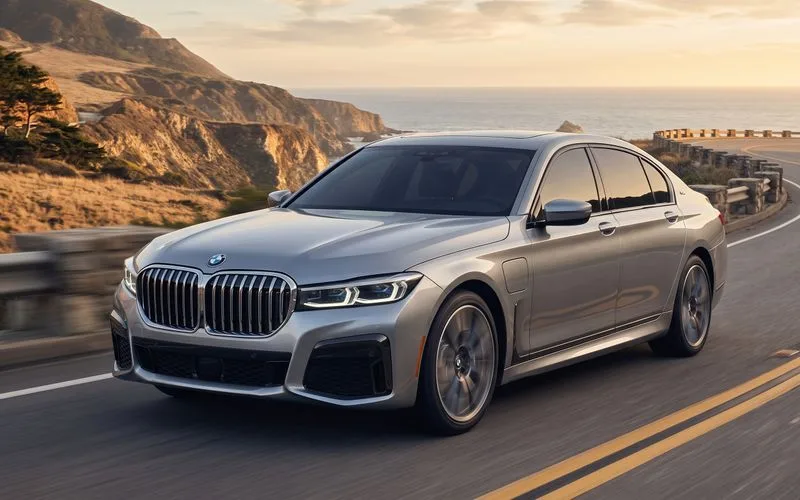 BMW 7 SeriesFull-Size Luxury SedanBetter at: Driving engagement
Costs more once equipped but offers hands-free Highway Assistant, a plug-in 750e and full i7 EV, and a chassis that rewards driving rather than just isolating you from it.
Compare 3.21B+
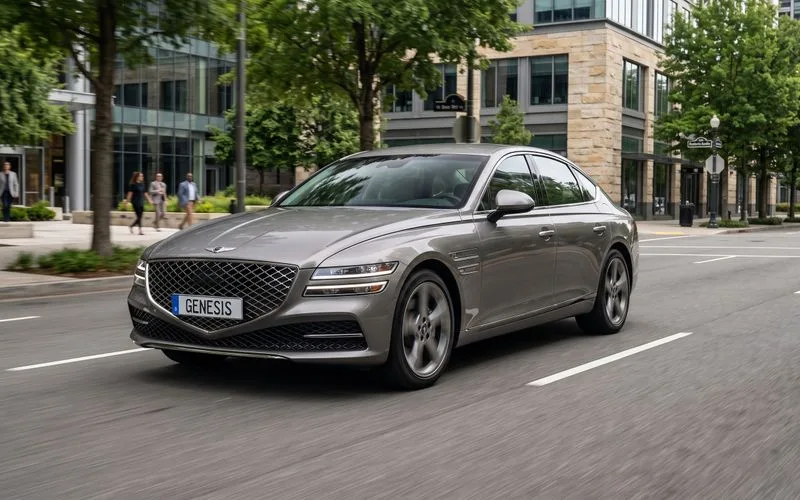 Genesis G80Mid-Size Luxury SedanBetter at: Value
Delivers most of the G90's design, materials and standard-safety story for tens of thousands less, with better resale and newer infotainment including wireless CarPlay.
Compare 3.20B+
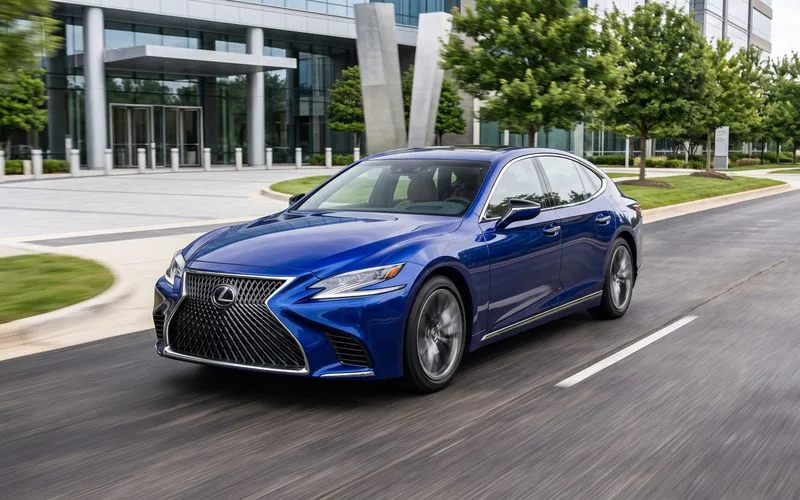 Lexus LSFull-Size Luxury SedanBetter at: Resale value
The safer long-term bet — stronger predicted reliability, roughly 47% five-year value retention against the G90's 37%, and a hybrid powertrain option to cut the fuel bill.
CompareHow it's evolved
10 scored model years · 2017–2026
Subject scores by year
Hover or tap a score to see what moved it versus the year before. A corner mark flags a big swing.
| Year | Performance | Efficiency | Safety | Space | Cost | Reliability | Tech | Use-case | Driving | Value |
|---|---|---|---|---|---|---|---|---|---|---|
| 2026 | 72 | 23 | 78 | 79 | 29 | 78 | 80 | 55 | 72 | 75 |
| 2025 | 71 | 19 | 74 | 73 | 29 | 67 | 80 | 53 | 68 | 74 |
| 2024 | 71 | 19 | 78 | 73 | 29 | 66 | 83 | 53 | 68 | 78 |
| 2023 | 71 | 19 | 79 | 73 | 29 | 63 | 80 | 52 | 68 | 77 |
| 2022 | 71 | 12 | 78 | 77 | 28 | 62 | 62 | 47 | 63 | 63 |
| 2021 | 68 | 13 | 80 | 77 | 28 | 59 | 62 | 47 | 63 | 67 |
| 2020 | 66 | 28 | 80 | 79 | 38 | 62 | 63 | 48 | 62 | 65 |
| 2019 | 66 | 16 | 62 | 80 | 28 | 74 | 55 | 48 | 63 | 66 |
| 2018 | 66 | 16 | 68 | 80 | 40 | 63 | 59 | 47 | 60 | 72 |
| 2017 | 65 | 18 | 68 | 80 | 42 | 66 | 53 | 45 | 64 | 69 |
Compare two years
Best fit & conditions
Higher scores mean a better fit for that use case. Learn more about use-case fit →
Subject profile
Detailed scoring by subject
1Performance & PowertrainMid-pack among this car's ten categories.2.42C+
The volume 3.3T Premium trim's twin-turbo 3.3L V6 is rated 365 hp; the step-up 5.0 Ultimate V8 offers 420 hp as the alternate trim.
Twin-turbo V6 delivers strong low-end torque typical of turbocharged full-size luxury sedans.
Independent instrumented tests of the launch-year 3.3T V6 cluster around 5.2-5.5 seconds to 60 mph; Motor Trend found the V8 RWD tester about 0.4 sec quicker than the V6.
Launch reviews praised the twin-turbo V6's smooth, quiet power delivery with minimal perceptible turbo lag, matching the G90's flagship-quiet cabin brief.
The 8-speed automatic shifts smoothly and unobtrusively in normal driving, though early reviewers noted occasional hesitation on kickdown for passing.
AWD (HTRAC) is offered as a roughly $2,500 option across both the 3.3T Premium and 5.0 Ultimate trims at launch (RWD standard), with no dedicated terrain modes or low-range hardware.
The 2017 G90 launches with two gasoline engine choices (3.3L twin-turbo V6, 5.0L naturally aspirated V8) but no hybrid, PHEV, or EV variant.
2Efficiency & RangeThe G90's lowest-graded category.0.00F
EPA rates the 3.3T V6 volume trim at 20 MPG combined for both RWD and AWD; the 5.0 Ultimate V8 is slightly lower at 19/18 MPG combined RWD/AWD.
EPA city rating for the 3.3T volume trim.
EPA highway rating for the 3.3T volume trim, at the bottom of the sedan normalization band.
EPA-reported full-tank range for the 3.3T volume trim on its 21.9-gallon tank at 20 MPG combined.
EPA's annual fuel cost estimate for the 3.3T volume trim, well above the sedan segment's normalization band due to premium-recommended fuel and a large V6.
Both the 3.3T and 5.0 engines are designed to run on 87-octane regular but Genesis recommends 91-octane premium for full performance, a middle-ground requirement rather than a strict premium mandate.
3SafetyOne of the G90's strongest categories.2.63C+
NHTSA has never published a crash-test rating for any model year of the first-generation G90 (2017-2022); it is a low-volume flagship of the kind the agency routinely skips, the same treatment as the 7 Series, S-Class and A8. Per the framework definition of this item, 0 is the value for a vehicle never rated by NHTSA — a sentinel for absent data, not a zero-star crash result.
The 2017 G90 earned IIHS Top Safety Pick+ — the top award — with Good ratings in all five crashworthiness tests plus head restraints & seats, a Superior front crash prevention rating, and a headlight rating good enough to qualify (Good on the 5.0 Ultimate, Acceptable on the volume 3.3T Premium). This is one of the strongest independent crash results in the segment for this model year.
Genesis launched the G90 with a no-options-list strategy: automatic emergency braking with pedestrian detection, Smart Cruise Control with full stop/start, Smart Blind Spot Detection, Lane Keep Assist, rear cross-traffic alert, driver attention alert and a 360-degree camera are all standard on both the base 3.3T Premium and the 5.0 Ultimate — nothing in this suite is optional or trim-gated, which is unusually complete for 2017 and beats every rival in this peer set at the time.
IIHS rated the standard AEB system Superior, its top tier: the G90 avoided a collision entirely in both the 12 mph and 25 mph vehicle-to-vehicle tests, and its pedestrian-detection system avoided hitting a pedestrian in the low-speed test and materially reduced impact speed in the high-speed test. This is a documented top-tier result, not a manufacturer claim.
Smart Blind Spot Detection and rear cross-traffic alert are standard on every trim, which is the segment-leading part of this score, but the 2017-generation system is alert-only (mirror indicator and audible warning) rather than an active-braking or steering-correction implementation, so it falls short of the top band reserved for active intervention.
Lane Keep Assist offers a standard mode (drift warning at the line) and an Active mode that centers confidently, including on winding roads above 70 mph according to reviewers — an unusually capable centering system for 2017, though it still requires periodic steering-wheel input and lacks the smoothing/predictive refinement of later Genesis Highway Driving Assist generations.
Smart Cruise Control brings the car to a complete stop from highway speed and resumes automatically, and reviewers describe it working smoothly in combination with Lane Keep Assist — 'practically drives itself' in stop-and-go and steady highway traffic. It is standard equipment on every trim, with no options-list gate.
There is no hands-free highway driving system on the 2017 G90 at any trim — Lane Keep Assist and Smart Cruise Control both require regular steering-wheel contact and nag within about 15 seconds of hands-off use. No counterpart to Super Cruise or a later BlueCruise/Highway Assistant existed on any Genesis product in 2017.
IIHS rated headlights differently by trim: Good on the 5.0 Ultimate (LED projectors) but only Acceptable on the volume 3.3T Premium (HID projectors), both with curve-adaptive and high-beam-assist function. Since the volume trim is the representative configuration, this sits in the 'Good on upper trims, Acceptable on volume' band rather than the top.
Reviewers cite genuinely good natural sightlines — large front windows, a wide windshield, a moderately angled glass and low-mounted mirrors that don't block the view — on top of a standard 360-degree camera system praised as class-leading for its clarity and stitching quality, with two extra front-corner cameras for tight-space maneuvering. Both the natural glass and the camera compensation are standard rather than optional.
Real-world car-seat fit is strong — Grade A results for infant, rear-facing convertible, forward-facing convertible and booster seats, in a spacious back seat — but the lower LATCH anchors sit noticeably deep in the stiff leather seat bight, which IIHS marks down to an Acceptable ease-of-use rating. Held in the upper half of the middle band: good outcomes, held back by anchor access rather than space.
4Space & ComfortThe G90's best-graded category.3.43B+
The 2017 G90 seats five in a standard 2-row configuration on both the 3.3T Premium and 5.0 Ultimate.
Front headroom is generous for the segment, reflecting the G90's tall roofline and flagship packaging.
Front legroom is among the largest in the class, aided by the G90's long wheelbase.
Rear headroom is solid for a full-size luxury sedan despite the sloping rear roofline typical of the segment.
Rear legroom is good and reviewers praise the extra wheelbase for making the back seat 'very spacious,' though it trails some stretched-wheelbase full-size rivals.
Trunk volume is average-to-below-average for the full-size luxury sedan class; a standard ski pass-through partially offsets the lack of folding rear seats.
Everyday storage is competent — a sizable center console, door pockets and front/rear USB ports — but nothing distinctive, and the lack of folding rear seats or a pass-through beyond skis limits flexibility.
The standard 22-way power driver's seat and 16-way passenger seat are repeatedly praised as supremely comfortable with a firm-yet-supple cushion balance, and standard heated/cooled front and rear seats extend that comfort to all four occupants.
The standard adaptive suspension delivers a supple, steady highway ride that reviewers compare favorably to the S-Class, smoothing bumps while keeping the body controlled.
Multiple reviewers single out the cabin as exceptionally isolated from wind, road and engine noise, with one describing it as 'tomb-silent' — a top-tier result even among full-size luxury sedans.
Tri-zone automatic climate control, heated and ventilated front seats, heated rear seats, and power rear side sunshades are all standard equipment on the volume 3.3T Premium trim — a rich comfort package with nothing gated to the Ultimate.
5Cost of OwnershipOne of the G90's weakest categories.0.80F
Entry point to the 2017 G90 lineup was the 3.3T Premium RWD; AWD added $2,500.
Flagship buyers in the G90's first US model year skewed toward the V8 Ultimate for the extra power and standard equipment over the V6 Premium, which was only marginally cheaper.
Industry cost-of-ownership trackers put the G90 modestly below its luxury-sedan peer average for combined maintenance and repairs, though flagship-specific electronics (adaptive suspension) carry some repair risk.
iSeeCars data shows the G90 depreciating slightly less than the full-size luxury sedan segment average (52.7% vs. 54.9%), and the 2017 model year specifically posted the highest resale value among segment peers.
Genesis's basic warranty at launch was the longest bumper-to-bumper coverage among mainstream luxury flagships (Mercedes/BMW/Audi typically offer 4 yr/50,000 mi).
10-year/100,000-mile powertrain coverage is among the longest in the industry, matched only by corporate siblings Hyundai/Kia and a handful of others.
Genesis launched the G90 with a white-glove ownership program: 3 years/36,000 miles of complimentary scheduled maintenance (including wiper blades, alignment, brake pads), plus 3 years of valet pickup-and-delivery service for maintenance visits — well beyond a typical roadside-assistance-only package.
$69,700 volume-trim price minus its estimated resale value after 5 years (47.3% retained, or about $32,968) leaves about $36,732 in depreciation. Add the projected $2,822 in 5-year maintenance and repairs, and owning this vehicle for 5 years costs about $39,554 in total.
6Reliability & QualityMid-pack among this car's ten categories.2.43C+
As an all-new nameplate for MY2017 (launched Sept 2016 as the brand's flagship, badge-engineered from the Hyundai EQ900), the G90 had no track record at launch. Owner satisfaction has been strong (KBB: 4.8/5 reliability, 95% recommend among early owners), but NHTSA complaint data for the generation skews toward powertrain/engine/fuel-system issues, and the model was later subject to multiple fire-risk recalls — mixed signals typical of a first-year model from a brand-new luxury division.
Genesis, though brand-new in 2017, went on to rank #1 among all brands (not just luxury) in J.D. Power's 2020 U.S. Vehicle Dependability Study (89 PP100) in its first eligible year, and was J.D. Power's top-ranked brand in Initial Quality multiple years running (2019, 2020) — an unusually strong dependability standing for the generation this 2017 model belongs to.
The 2017 G90 (3.3T engine) is covered by repeated, fire-risk-specific recalls across its generation: a starter-solenoid water-intrusion short circuit that can cause an engine-compartment fire (2017-2019 G90), a turbocharger oil supply pipe seal leak onto the exhaust manifold risking fire (2017-2018 G90), and a later turbocharger oil feed pipe deterioration/leak fire risk (2017-2022 G90, NHTSA campaign 24V191). Three separate fire-risk campaigns against one generation is a repeated pattern in a safety-relevant system, not an isolated minor issue.
The 2017 G90's 3.3L twin-turbo V6 (Lambda II) and optional 5.0L V8 (Tau) are Hyundai/Kia engine families with years of prior use elsewhere in the lineup, giving them a reasonably proven base — but the G90 application specifically has generation-wide owner reports of coolant leaks (both 3.3 and 5.0 variants) and unresolved high-speed vibration/shake complaints, plus the fire-risk turbo oil-line recalls above, keeping this short of a clean durability record.
Reviewers consistently rated the first-generation G90's cabin as class-leading for the price, citing genuine wood and metal trim (developed with Italy's Pasubio leather house), soft-touch surfaces throughout, and Nappa leather — undercutting German full-size luxury rivals on materials cost while matching much of their perceived quality.
Contemporary reviews described assembly as tight and "impeccable, rivaling pricier brands," but the generation carries a well-documented panoramic-sunroof issue (loose/under-torqued frame bolts causing creaks, rattles and wind noise, with one documented case of 32 loose bolts) and intermittent power-trunk latch misalignment — real, recurring assembly-quality complaints that keep this below a top-tier score.
In 2017 Genesis had just spun off from Hyundai as its own brand and had no dedicated standalone dealerships yet — the G90 was sold and serviced through a limited set of authorized Hyundai dealer showrooms pending the brand's later (2019+) rollout of dedicated Genesis retail locations, making coverage thin in this specific model year even though Genesis did offer a valet pickup/delivery service to compensate.
Genesis draws on Hyundai's large existing parts supply chain, keeping parts reasonably available, and complimentary maintenance (3 years/36,000 miles) plus a long 5-year/60,000-mile bumper-to-bumper and 10-year/100,000-mile powertrain warranty offset early ownership costs; Edmunds' 10-year cost-to-own data for the platform runs below the luxury-sedan average, though this data point is drawn from a later model year and independent-shop familiarity with the marque is still building.
7Technology & InfotainmentGrades below the middle of the scale.1.58D
A single 12.3-inch center touchscreen is standard across the 2017 G90 lineup, unusually large for the era though it 'looks tiny' in the wide dashboard.
The system's graphics are sharp and touch response is decent for 2017, but the menu structure is an older Hyundai-derived layout, and the lack of any smartphone-projection fallback (see 7.1.3) means owners are locked into native software that reviewers consider dated rather than best-in-class.
Apple CarPlay and Android Auto are not offered on the first-generation G90 at all — factory support didn't arrive until the 2020 model year — so 2017 owners are limited to the native infotainment system or aftermarket retrofit hardware.
The G90 ships with a built-in navigation system and voice command as standard equipment, functional for destination entry and basic commands, but 2017-era Hyundai/Genesis voice recognition is not natural-language and reviewers give it little attention relative to competitors' systems.
A 17-speaker, 900-watt Harman Kardon Lexicon surround-sound system with Quantum Logic and Clari-Fi restoration is standard on the volume 3.3T Premium trim — a segment-leading premium audio setup with no upcharge.
A fully digital LCD gauge cluster is standard across the 2017 G90 lineup, integrating blind-spot camera and trip data displays — advanced for the model year, though its graphics and configurability are more basic than later Genesis clusters.
The 2017 G90 predates Genesis/Hyundai's over-the-air update rollout; software and map updates of this era are handled via dealer visits or USB, with no whole-vehicle or infotainment OTA capability.
Genesis Connected Services (Blue Link-based) offers remote start, climate control, lock/unlock and vehicle locate through a smartphone app on a complimentary trial, but multiple 2017 G90 owners report the service failing to activate or work reliably, requiring a dealer USB reset.
Standard Qi wireless phone charging plus front and rear USB ports covers the basics well for 2017, though it predates USB-C and offers no household AC outlet.
Proximity key entry and push-button start are standard on the volume trim, and app-based remote start is available through Genesis Connected Services, though there is no phone-as-key digital key feature (not yet introduced on any 2017-era Genesis/Hyundai product).
A 360-degree multi-view camera system with front-corner cameras is standard on the volume trim and singled out by reviewers as exceptionally sharp and well-stitched, paired with standard front and rear parking sensors — a genuine standout for the model year.
A full-color head-up display is standard equipment on the volume 3.3T Premium trim rather than gated to the range-topping Ultimate — an unusually generous placement for 2017.
8Use-Case FitOne of the G90's weakest categories.1.02D
Real-world car-seat fit is strong (Grade A for infant, convertible and booster seats in a spacious rear cabin), but the LATCH lower anchors sit deep in the seat bight and the lack of split-folding rear seats limits stroller/gear flexibility on daily family runs.
The G90 earned IIHS Top Safety Pick+ with a Superior front crash prevention rating, and its full ADAS suite — AEB with pedestrian detection, blind-spot monitoring, lane keep assist, adaptive cruise, rear cross-traffic alert — is standard on every trim with no options-list gate, a strong result even though NHTSA never crash-tested this low-volume flagship.
Standard tri-zone climate, heated/cooled rear seats and power rear sunshades make multi-hour trips comfortable for rear-seat passengers, but the below-average 15.7 cu ft trunk caps how much gear a family can bring along.
The adaptive suspension and light, easy-effort steering make the G90 relaxed in traffic, and adaptive cruise with lane keep assist practically drives itself in stop-and-go conditions, though its full-size footprint adds some fatigue threading through tight streets.
EPA-rated 20 MPG combined (3.3T V6) is well below average for a daily commuter, and Edmunds' long-term testers found real-world fuel economy running worse than the EPA estimate, compounded by luxury-tier consumables and service costs.
At 204.9 inches long with a roughly 39-foot turning circle, the G90 is a genuine handful in tight urban parking, but the standard 360-degree camera and front/rear sensors materially ease the process.
As a full-size luxury flagship sedan, the G90 has no published towing capacity, no cargo bed, and a small trunk with no folding seats — it is not meaningfully work-capable by design.
Genesis/Hyundai mechanicals have a reasonable general reliability reputation, but the G90's Nappa leather cabin and luxury-focused engineering are not designed for fleet or work abuse, and no fleet-use track record exists for this low-volume flagship.
The G90 offers no onboard power outlets for tools, no tie-downs, no rack or upfit ecosystem, and a leather-trimmed cabin with no washable work-duty surfaces.
Reviewers repeatedly describe the G90 as an exceptional highway cruiser — 'the kind of car you could drive for hours on end and arrive feeling relaxed and refreshed' — backed by a hushed cabin, standard adaptive cruise, HUD and heated/cooled seats for driver-fatigue reduction on long hauls.
Optional HTRAC AWD adds foul-weather traction, but the G90 has low sedan ground clearance, no off-pavement equipment, and no roof rack or accessory ecosystem — it is fundamentally pavement-bound.
A standard ski pass-through helps with long, narrow items, but the below-average 15.7 cu ft trunk and the complete absence of split-folding rear seats leave little flexibility for bulky gear.
9Driving ExperienceMid-pack among this car's ten categories.2.32C+
The G90 grips well and feels agile for its size, with the adaptive suspension improving body control in corners, but reviewers note it leans into turns and struggles to settle back to straight-line travel — secure and composed rather than genuinely sporty.
Multiple reviewers criticize the standard steering calibration as too light and largely numb, though drive-mode selection offers some improved weighting; feedback has 'never been a strength' for this generation.
Edmunds' instrumented testing found a competitive 112-foot stop from 60 mph on all-season tires with a light, easy-to-modulate pedal and stable behavior at maximum effort, though the car pitches forward more in its softer suspension settings.
The twin-turbo V6 and 8-speed automatic deliver smooth, well-isolated power in normal driving, though early reviewers flagged occasional hesitation on kickdown when demanding a quick passing burst.
The powertrain is exceptionally well isolated at idle and under load, contributing directly to a cabin reviewers describe as 'tomb-silent' with an 'extremely soft engine idle.'
The G90's turning circle sits near the wide end of the sedan band, a direct consequence of its 204.9-inch overall length and full-size flagship footprint.
The standard 22-way power driver's seat and 16-way passenger seat provide an unusually wide adjustment range, paired with a driver-focused layout and good sightlines that reviewers single out as easy to live with.
Sport mode brings genuinely engaging, communicative moments with sharper steering weight and grip, but body roll persists even in Sport, and reviewers consistently frame the G90 as a relaxed luxury cruiser rather than an enthusiast's car.
10Value & Market PositionOne of the G90's strongest categories.2.66C+
Even the base 3.3T Premium came loaded with a panoramic sunroof, HUD, Lexicon audio, ventilated/heated front and heated rear seats, and full driver-assist suite — content that German and Japanese rivals gate behind expensive option packages.
At $68,100–$72,200, the G90 undercut established ultra-luxury flagships (S-Class, 7 Series, A8, LS) by roughly $20,000 while matching most of their feature content, making it a standout bang-for-buck pick in the segment.
Only two trims (3.3T Premium, 5.0 Ultimate), each offered in RWD or AWD — a narrow, take-it-or-leave-it lineup versus rivals' many trim/option tiers.
As a brand-new nameplate from a brand-new luxury division, the G90 sold in the low thousands annually in the US — a rounding error next to the S-Class or 7 Series, and a slow seller even within the tiny full-size luxury sedan segment.
Genesis had only just split off from Hyundai as a standalone luxury brand in late 2015/2016; strong owner satisfaction scores existed but broad market prestige and brand recognition were still unbuilt in 2017, well behind the German and Lexus establishment.
As a new entrant trying to win over buyers loyal to established flagships, Genesis dealers commonly offered generous lease deals and negotiating room on the G90 rather than at-MSRP or over-MSRP pricing.
2017 was the first US model year of the all-new first-generation G90 (launched at the 2016 NAIAS, on sale from September 2016) — as fresh and current as a nameplate gets, with no redesign due for years.
The 2017 G90 earned an IIHS Top Safety Pick+ and was rated the top overall vehicle across all categories in AutoPacific's New Vehicle Satisfaction Awards, plus solidly positive reviews (7.8/10 TCC, 8.6/10 US News) — well-reviewed and award-winning, though not yet a fixture of head-to-head comparison-test wins against the established flagships.