

The verdict
A mixed-report compact hatchback, strong on reliability and held back by performance.
The 2024 Civic Hatchback is the practical, sweet-driving compact that a lot of shoppers should buy and almost nobody regrets — 24.5 cubic feet of cargo behind the back seat (a third more than a Corolla Hatchback and 10 more than a Civic sedan's trunk), a five-star NHTSA rating, 32 MPG combined on regular gas, and a chassis good enough that Car and Driver put the Civic on its 10Best list for a third straight year. What it is not is quick or gadget-rich: the volume $27,445 Sport uses a 158-hp four that needs about 8.9 seconds to reach 60 mph, and it ships with a 7-inch screen, wired-only CarPlay, no blind-spot monitoring at any price, and no hybrid — Honda saved that for the 2025 refresh. Buy it for how it drives, how much it swallows, and how cheap it is to keep; skip it if you want power, screens, all-wheel drive, or a quiet highway cruise.
Jump to scoresStrengths
- Cheap to own, and it holds its value
- Honda mechanicals with the deepest parts supply in the class
- Five-star safety with the good gear standard on the cheapest trim
What holds it back
- The volume engine is genuinely slow
- The tech is a generation behind, and the good stuff is locked to the top trim
- You cannot buy blind-spot monitoring on the trim most people buy
Top alternatives
Cars shoppers cross-shop with the Honda Civic Hatchback 2.25C
2.25C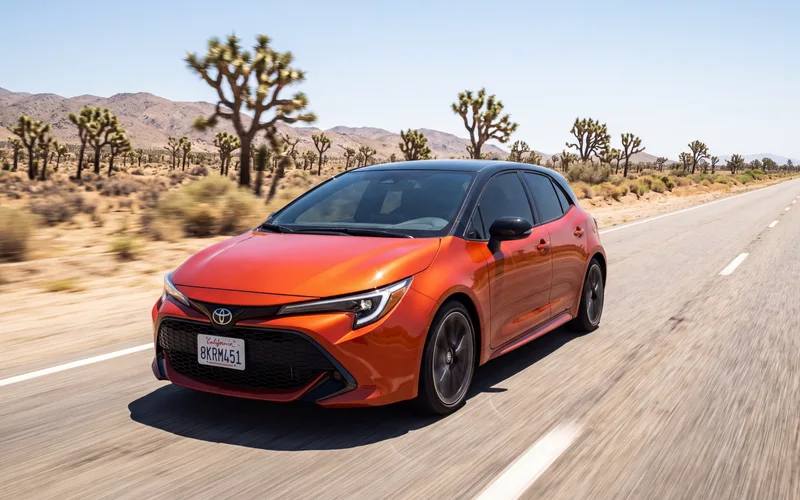 Toyota Corolla HatchbackCompact HatchbackBetter at: Value
Costs less, discounts more freely, and gives you wireless CarPlay on mid trims — worth a look if budget and tech convenience outrank cargo space.
Compare 2.57C+
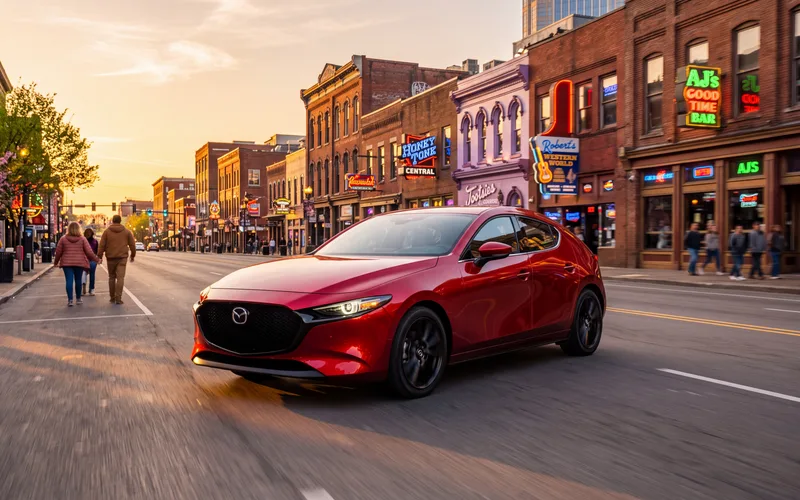 Mazda Mazda3 HatchbackCompact HatchbackBetter at: Interior quality
Offers AWD and a genuinely premium-feeling interior with a head-up display, for buyers who'd trade cargo volume for polish and all-weather traction.
Compare 2.14C
2.14C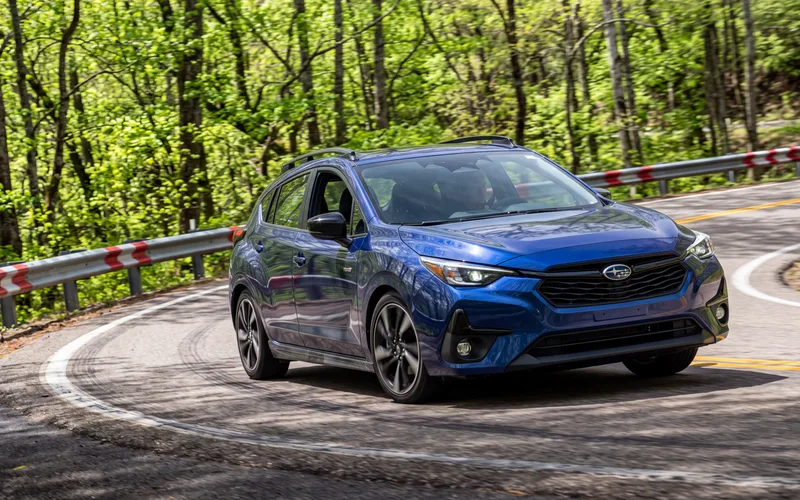 Subaru ImprezaCompact HatchbackBetter at: All-weather traction
Standard all-wheel drive at a lower price makes it the default choice for snow-belt buyers the FWD-only Civic can't serve.
CompareHow it's evolved
10 scored model years · 2017–2026
Subject scores by year
Hover or tap a score to see what moved it versus the year before. A corner mark flags a big swing.
| Year | Performance | Efficiency | Safety | Space | Cost | Reliability | Tech | Use-case | Driving | Value |
|---|---|---|---|---|---|---|---|---|---|---|
| 2026 | 30 | 59 | 76 | 69 | 68 | 80 | 51 | 65 | 72 | 75 |
| 2025 | 25 | 59 | 78 | 65 | 68 | 80 | 48 | 60 | 66 | 72 |
| 2024 | 27 | 54 | 73 | 68 | 69 | 77 | 45 | 55 | 70 | 73 |
| 2023 | 25 | 53 | 77 | 69 | 77 | 79 | 43 | 56 | 68 | 79 |
| 2022 | 25 | 54 | 81 | 69 | 78 | 78 | 43 | 56 | 68 | 80 |
| 2021 | 34 | 46 | 68 | 66 | 72 | 77 | 40 | 53 | 69 | 67 |
| 2020 | 35 | 45 | 69 | 66 | 75 | 74 | 39 | 53 | 70 | 77 |
| 2019 | 34 | 46 | 67 | 65 | 76 | 71 | 30 | 51 | 69 | 75 |
| 2018 | 32 | 60 | 58 | 74 | 76 | 65 | 34 | 58 | 77 | 75 |
| 2017 | 31 | 60 | 63 | 69 | 78 | 64 | 36 | 52 | 69 | 80 |
Compare two years
Best fit & conditions
Higher scores mean a better fit for that use case. Learn more about use-case fit →
Subject profile
Detailed scoring by subject
1Performance & PowertrainThe Civic Hatchback's lowest-graded category.0.00F
The volume Sport hatchback uses the naturally aspirated 2.0-liter i-VTEC rated 158 hp at 6,500 rpm; the 1.5-liter turbo on EX-L and Sport Touring is the lineup ceiling at 180 hp. This is the pre-refresh eleventh-generation tune — Honda dropped the 2.0L to 150 hp for the 2025 refresh, so 2024 is not interchangeable with later years.
The volume 2.0-liter makes 138 lb-ft at a high 4,200 rpm, which is the weak point of this powertrain — the optional 1.5T's 177 lb-ft arrives from 1,700 rpm and transforms drivability, but it is not the representative configuration.
Honda publishes no 0–60 figure. Instrumented tests of the same 158-hp 2.0L/CVT put the sedan at 8.8 s and MotorTrend recorded 9.2 s for a 2024 Civic Sport; the hatchback carries a modest weight penalty over the sedan, so ~8.9 s is the representative figure. The turbo trims are roughly 1.4 s quicker.
The naturally aspirated 2.0-liter is linear and lag-free with well-judged throttle response, but thin mid-range torque makes it vocal and strained under hard acceleration. The optional 1.5T is stronger and equally smooth, and there is no hybrid in the 2024 U.S. lineup to lift the average.
Honda's LL-CVT with G-Design Shift is among the best CVTs sold — simulated ratio steps and torque-converter integration largely suppress rubber-banding — and the Sport and Sport Touring hatchbacks uniquely offer a genuinely good 6-speed manual, which the sedan's equivalent trims do not. Held below the top band because the CVT still holds revs and drones at full throttle.
Every 2024 Civic Hatchback trim is front-wheel drive; Honda has never offered AWD on this platform. That is a clear deficit against the Subaru Impreza (AWD standard) and the AWD-optional Mazda3 Hatchback and Toyota Corolla Hatchback.
Two distinct gas engines (158-hp 2.0L NA, 180-hp 1.5T) with a choice of CVT or 6-speed manual on the sporting trims covers mainstream economy and warm-hatch needs, but there is no electrified option at all for 2024 — the U.S. Civic hybrid did not arrive until the 2025 refresh — and no Si variant on the hatchback body. That caps this at the low end of the two-or-three-choices band.
2Efficiency & RangeOne of the Civic Hatchback's weakest categories.1.59D
EPA rates the volume Sport hatchback with the 2.0L and CVT at 32 MPG combined. The LX CVT is the frugal end at 33 and the 1.5-turbo EX-L is actually the range leader at 35, while the Sport 6MT is the thirstiest at 29.
29 MPG city for the volume Sport CVT — solid for a non-hybrid compact, helped by standard idle-stop, but well short of what the hybrid that arrived a year later delivers.
37 MPG on the EPA highway cycle for the Sport CVT. The turbocharged EX-L is the highway champion of the lineup at 39 MPG, since the small turbo engine loafs at cruise.
EPA computes 397 miles of total range from the 12.4-gallon tank and 32 MPG combined. The tank is small in absolute terms — this is the compact-hatch trade-off, and range is the one place the Civic's efficiency does not translate into a strong figure.
EPA's own estimate for the volume Sport CVT at 15,000 miles a year on regular unleaded, and it saves roughly $1,500 over five years against the average new vehicle at 28 MPG.
Every 2024 Civic Hatchback trim — naturally aspirated and turbocharged alike — is specified for regular unleaded, so there is no premium penalty even on the 1.5T, and no charging or alternative-fuel logistics to manage.
3SafetyOne of the Civic Hatchback's strongest categories.2.93B-
NHTSA rated the 2024 Civic Hatchback separately from the sedan and awarded its maximum overall score, with the frontal sub-score the only four-star result.
The 2024 Civic Hatchback holds a 2024 Top Safety Pick (not TSP+), with Good small-overlap front on both sides and Good original moderate overlap, but only Acceptable in the updated side test — driver pelvis forces rated Marginal — and it has not been run in the updated moderate-overlap (rear-passenger) test.
Honda Sensing is standard on every 2024 Hatchback trim — CMBS forward-collision braking with pedestrian detection, adaptive cruise with Low-Speed Follow on CVT cars, lane keeping assist, road departure mitigation, traffic jam assist, traffic sign recognition and auto high-beam — but blind-spot monitoring is not merely optional on LX and Sport, it is unavailable, and cross-traffic alert is confined to the top Sport Touring.
The standard Collision Mitigation Braking System rates only Acceptable in IIHS pedestrian front crash prevention: it cleanly avoided both daytime crossing-child runs, but nighttime crossing-adult results were partial speed reductions rather than avoidance, and the rating leans on a high-beam-assist credit.
The two cheapest trims cannot be ordered with blind-spot monitoring at any price; EX-L adds alert-only BSI, and only the range-topping Sport Touring gets Cross Traffic Monitor plus the rear Low-Speed Braking Control that intervenes.
Lane departure warning, lane keeping assist and road departure mitigation are standard on all trims and reviewers find the centering steady and predictable rather than ping-pongy, though it is a lane-keeping system that needs clear markings and hands on the wheel, not a premium centering assistant.
Adaptive cruise with Low-Speed Follow is standard on the CVT trims that make up the volume of hatchback sales and pairs with Traffic Jam Assist for full stop-and-go work; the manual-transmission Sport and Sport Touring lose Low-Speed Follow, and there is no branded highway-assist tier above it.
Honda offered no hands-free highway system on any 2024 Civic; Honda Sensing is a hands-on suite with a steering-torque nag, and there is no BlueCruise/Super Cruise equivalent anywhere in the trim walk.
Every 2024 Hatchback trim gets the same IIHS Good-rated LED reflector headlights with standard high-beam assist, so the cheapest car sees as well as the most expensive one; the only demerits are some low-beam glare and no curve-adaptive function.
Forward and three-quarter sightlines are a deliberate strength of this generation — A-pillars pulled back nearly two inches, mirrors moved off the pillar, a low cowl and low beltline — but the hatchback's steeply raked rear glass and spoiler cut the over-shoulder view versus the sedan, and no surround-view camera is offered on any trim.
LATCH hardware on this generation is easy to work with — two sets of lower anchors under a single fabric flap and three body-colored top tethers under a hinged plastic cover — and testers installed both infant and rear-facing convertible seats without trouble, but a compact hatchback back seat is still a two-seat proposition with a front-seat compromise for rear-facing installs.
4Space & ComfortMid-pack among this car's ten categories.2.63C+
Every 2024 Civic Hatchback trim seats five — front buckets plus a 60/40-split three-place bench — which is the maximum the compact-hatchback band recognizes.
The volume Sport has no moonroof, so it keeps the full 39.3 inches of front headroom — near the top of the compact-hatch range. Ordering an EX-L or Sport Touring costs 1.7 inches to the moonroof housing.
42.3 inches of front legroom is mid-pack for a compact hatchback and unchanged across the trim walk, though reviewers note the Sport's manual driver's seat limits how much of it a tall driver can exploit comfortably.
37.1 inches in the second row is average for the class — the hatchback's rear roofline is fractionally lower than the sedan's, and unlike the front measurement it does not vary with the moonroof.
37.4 inches of rear legroom sits just above the middle of the hatchback band and is a fraction less than the Civic sedan's, but it is enough that testers rate the back seat genuinely usable for two adults rather than token.
24.5 cubic feet behind the second row is one of the largest figures in the compact class — roughly a third more than the Corolla Hatchback — and it is the single strongest argument for the hatchback body over the Civic sedan's 14.8 cu ft trunk.
The eleventh-generation cabin is well organized rather than innovative: a deep two-level center console with a sliding tray, a large open shelf ahead of the shifter, big bottle-holding door pockets and a low, wide hatch sill with a flat load floor. There is no standout trick — no underfloor cargo well, no onboard AC power, and the volume Sport does not even get the wireless charging pad that is confined to the Sport Touring.
The body-stabilizing front buckets are widely called supportive and well shaped, but the volume Sport gets a manual driver's seat with no lumbar adjustment at all — power adjustment and heating start at EX-L — and owners specifically fault the seatback on longer stints. The rear bench has a usefully reclined backrest angle for the class.
The suspension is well damped and settled at a cruise, but the Sport's 18-inch wheels are the trim's ride penalty — Consumer Reports found the ride stiff and choppy with big jolts over broken pavement, where the 16- and 17-inch LX and EX-L are noticeably more forgiving.
Noise is this car's clearest comfort weakness and the criticism is unusually consistent: the hatchback's open cargo bay behind the rear seats lets tire roar into the cabin, and reviewers report having to raise their voices at highway speed even on new pavement. Honda's spray-foam and insulation work helps at low speed but does not fix it.
The volume Sport makes do with single-zone climate control, cloth seats and no heat anywhere; heated front seats, dual-zone automatic climate and a moonroof all start at EX-L, and power front seats at Sport Touring. Nothing in the 2024 lineup offers a heated steering wheel, ventilated seats or rear seat vents, though remote engine start is standard from Sport up.
5Cost of OwnershipMid-pack among this car's ten categories.2.69C+
Unlike the 2025-and-later hatchback lineup, the 2024 car still opens with a true LX entry trim, putting the hatchback's floor about $2,000 lower than the refreshed cars that replaced it. Well under the middle of the hatchback price band.
Sport is the volume hatchback trim — it adds 18-inch wheels, dual-zone climate and remote start over LX for $1,400 while keeping the 158-hp 2.0L, and the 6-speed manual is a no-cost alternative to the CVT. The 1.5T EX-L and Sport Touring sit above it at $29,745 and $32,545.
Estimates diverge mostly on methodology rather than on the car: CarEdge counts scheduled service only, Edmunds folds in tires, brakes, battery and unscheduled work. The midpoint sits comfortably below the compact-hatchback average, reflecting Honda's cheap parts and the naturally aspirated 2.0L's simplicity.
Near the top of the compact-hatchback field — Civic residuals are consistently the segment benchmark alongside the Corolla, and the 2024 car's pre-refresh styling has not hurt it. Slightly behind the post-refresh hybrid hatchbacks, which draw stronger used demand.
Honda's standard bumper-to-bumper term, unchanged for 2024 — at the segment floor, well behind the Hyundai Elantra and Kia Forte at 5 yr / 60,000 mi.
Standard Honda 5/60k powertrain coverage — level with Toyota, Mazda and VW but half the Hyundai/Kia 10 yr / 100,000-mile term. The 2024 hatchback is gas-only, so no hybrid-battery coverage applies.
Honda Service Pass covers factory-scheduled maintenance — oil changes, tire rotations, multi-point inspections — for 2 yr / 24,000 mi, roughly matching ToyotaCare (2/25k) but short of Hyundai's 3/36k. Roadside assistance runs 3 yr / 36,000 mi alongside the basic warranty, and the HondaLink connected-services trial is brief; there are no charging credits or other meaningful extras on a gas compact.
$27,445 volume-trim price minus its estimated resale value after 5 years (59% retained, or about $16,193) leaves about $11,252 in depreciation. Add the projected $4,150 in 5-year maintenance and repairs, and owning this vehicle for 5 years costs about $15,402 in total.
6Reliability & QualityThe Civic Hatchback's best-graded category.3.20B+
The two major sources split on the 2024 car: J.D. Power rates it 'Great' in the low 80s while Consumer Reports' owner survey pulls the 2024 model year back to about average, down from the above-average verdict the 2023 Civic earned. Steering complaints and scattered oil-leak and infotainment reports are what separate it from the top band.
Honda's standing depends on which methodology you read: Consumer Reports puts the brand in the top five, but the J.D. Power dependability study has Honda meaningfully worse than the industry average for three-year-old vehicles. Strong but not uniformly elite, so a high-70s score reflects the split rather than either extreme.
Three recalls, two of them steering-related, and the gearbox campaign is systemic across the eleventh generation rather than an isolated batch defect — roughly 1.7 million Honda and Acura vehicles. The count is lower than the 2023 Civic's and the remedies are straightforward with no reported crashes or injuries, which keeps this above the bottom band but well short of a clean record.
The volume Sport hatchback runs the naturally aspirated 2.0-liter i-VTEC and CVT — mature, low-complexity Honda hardware with a good high-mileage record and none of the turbo's history. The optional 1.5-liter turbo carries the earlier oil-dilution reputation, addressed by design and software changes but not fully forgotten, and CR logs a handful of timing-cover seal oil leaks, so this stays below the top decile.
The Civic cabin remains a compact-class benchmark, with the honeycomb mesh vent panel, soft-touch dash surfaces and real physical controls reading well above the price. It falls short of a top score because Honda pulled soft-touch upper door panels up to the higher trims for this generation, so the volume Sport gets more hard plastic on the doors than the previous Civic did.
US-market Civic Hatchback assembly is at Honda's Greensburg, Indiana plant, and by 2024 the body is in its third model year of production, past first-launch tooling risk; Honda placed in the top ten brands in the 2024 initial-quality study. Owner-reported paint/trim and noises-and-leaks items, plus the misassembled driver's seat frame recall, keep it just below the strong band.
Honda runs one of the densest mainstream dealer networks in the country, and the Civic's enormous installed base means trained technicians and familiarity with the car everywhere, urban or rural. Franchise-level service quality varies and Honda trails Toyota/Lexus in customer-service studies, so this is strong rather than best-in-industry.
The hatchback shares essentially all of its mechanical hardware and most body structure with the far higher-volume Civic sedan, so OEM, salvage and aftermarket supply is as deep as anything in the segment. Repair frequency and annual cost sit far below compact-car averages — the clearest ownership strength in this category.
7Technology & InfotainmentOne of the Civic Hatchback's weakest categories.0.97F
Three of the four 2024 hatchback trims — including the volume Sport — carry the same 7.0-inch display, which is the floor of the normalization band and small by 2024 standards. The 9.0-inch HD unit is locked to the $32,545 Sport Touring.
Honda's layout is a genuine strength — a real volume knob, physical climate dials below the screen, and large fixed Home and Back buttons make it easy to use without looking — but the 7.0-inch unit on the volume trim is small, modest in resolution and dated in graphics next to rivals fitting 10-inch-plus screens as standard.
Wired Apple CarPlay and Android Auto are standard on every trim, but wireless projection requires the 9-inch head unit and is therefore confined to the single top Sport Touring — three of four trims, and the volume Sport, need a cable.
The volume Sport has no built-in navigation at all — Honda Satellite-Linked Navigation comes only with the Sport Touring's 9-inch system — and the embedded voice recognition is a command-word system that owners bypass in favour of Siri or Google Assistant through phone projection.
The Sport's 8-speaker, 180-watt system is a clear step above the LX's 4-speaker, 160-watt unit and adequate for the class, and a genuinely good 12-speaker Bose with subwoofer is available — but only on the top trim, and testers flag the head unit's shortage of tuning shortcuts.
LX, Sport and EX-L run a 7-inch colour driver display paired with a conventional analogue-style outer dial rather than a true full-digital binnacle; the fully digital 10.2-inch cluster — praised for its live display of which lighting and driver-assist elements are active — is Sport Touring-only.
There is no whole-vehicle over-the-air update capability on the 2024 Civic. HondaLink's OTA function delivers occasional infotainment/telematics fixes to connected cars — Honda's own knowledge base documents it chiefly as a wireless-network modem upgrade — and nothing on this car gains features or powertrain calibration remotely the way a Tesla or Hyundai/Kia ccNC vehicle does.
HondaLink covers the core remote set — remote engine start/stop, lock/unlock, vehicle locator, health reports and service reminders — but the useful half is subscription-gated after short trials, there is no digital phone-as-key, and the app's own store ratings reflect long-standing reliability complaints.
The volume Sport is USB-A only — a data port plus a 2.5-amp charge port up front — with no USB-C anywhere, no wireless charging pad (Sport Touring only) and no household AC outlet on any trim. The Sport Touring's four 2.5A ports plus Qi pad is the lineup's high-water mark and still uses legacy connectors.
The Sport carries the full everyday keyless set — smart entry with walk-away auto lock, push-button start and remote engine start standard from Sport upward — which is more than the base LX gets. It stops short of the top band because there is no phone-as-key, no hands-free power tailgate, and remote start through the app needs a HondaLink subscription.
A multi-angle rearview camera with dynamic guidelines is standard on every trim and is good quality, but that is the whole story on the volume Sport: front and rear parking sensors are Sport Touring-only, no surround-view camera is offered at any price, and there is no automated parking function.
Honda offered no head-up display on any 2024 Civic Hatchback trim, factory or accessory — driver information is confined to the gauge cluster display.
8Use-Case FitGrades below the middle of the scale.1.69D
LATCH hardware is unusually easy to work with for a compact — two sets of lower anchors under one fabric flap and three body-coloured top tethers — and the hatch's low, wide opening swallows a stroller without the sedan's trunk-lip fight. What holds it mid-pack is size: it is a two-car-seat back seat, rear-facing installs cost the front passenger some travel, and the low roofline means lifting a toddler down into the car rather than across.
The credentials are strong at family price points — NHTSA five stars overall, an IIHS Top Safety Pick, and the full Honda Sensing suite with adaptive cruise, lane keeping and pedestrian-capable automatic braking standard on the cheapest trim. The gap is that blind-spot monitoring cannot be ordered on LX or Sport at any price, cross-traffic alert is top-trim-only, and there is no rear-seat-occupant reminder.
Cargo room is the strong half — 24.5 cu ft holds four people's luggage with the seats up, which few compacts manage. The rear half is thin: no rear air vents on any trim, no rear USB or amenities on the volume Sport, and the highway noise that makes conversation an effort is exactly the wrong trait for a car full of kids on a long drive.
This is the Civic's home ground: light, accurate controls, one of the best forward sightlines in the class thanks to the pulled-back A-pillars and low cowl, a CVT that is smooth and unobtrusive in traffic, and adaptive cruise with Low-Speed Follow plus Traffic Jam Assist standard on the automatic trims that make up hatchback volume.
32 MPG combined on regular unleaded, roughly $1,950 a year at 15,000 miles by EPA's own reckoning, with the cheapest parts and service network in the segment behind it. It falls short of the top band only because there is no hybrid option in the 2024 hatchback lineup — the 2025 refresh's two-motor system moves this figure a whole tier.
A compact footprint, excellent forward and three-quarter sightlines and a standard multi-angle rearview camera make city work easy, but the Sport's 18-inch wheels push the turning circle out to 38.1 ft against 36.1 ft for the LX and EX-L, and parking sensors are Sport Touring-only with no surround-view camera offered at all.
Honda publishes no towing rating for the US Civic Hatchback and there is no factory hitch; a 158-hp front-drive compact with 24.5 cu ft of covered cargo can move a tradesperson's toolbags and samples but nothing that constitutes real work capacity.
The volume trim's naturally aspirated 2.0-liter i-VTEC and CVT are mature, low-complexity hardware with a strong high-mileage record and the deepest parts supply in the class, which is genuinely reassuring for a high-mileage service or delivery role. But it is a passenger compact — cloth seats and carpet rather than wash-out surfaces, a low front air dam, and no fleet-duty variant.
There is essentially no work-oriented provision: no onboard AC power on any trim, no factory hitch or roof rails, a carpeted cargo floor with only basic hooks, and an accessory catalogue oriented toward all-season mats and a crossbar-style roof attachment rather than upfit hardware.
Adaptive cruise with Low-Speed Follow, supportive front seats and 397 miles of EPA range make it a competent tourer, but two things bite over a full day: sustained highway noise loud enough that occupants raise their voices, and a Sport driver's seat with no lumbar adjustment.
Front-wheel drive only — Honda has never offered AWD on this platform, unlike the AWD-standard Impreza and AWD-optional Mazda3 and Corolla Hatchback — with compact-car ground clearance, no tow rating and no factory roof rails. Flat-folding rear seats and an accessory roof-attachment kit cover bikes and gear on pavement and gravel, and nothing beyond that.
The best practical argument for this body: 24.5 cu ft under the hatch with the seats up, a 60/40 split that folds to a long flat floor, and a tall wide opening with a low sill that makes loading bulky items straightforward. Ceilinged only by the absence of roof rails, a hitch or underfloor storage.
9Driving ExperienceGrades above the middle of the scale.2.74B-
The eleventh-generation chassis is the compact class benchmark — a stiffer body, wider track and rear multi-link setup give it quick turn-in, minimal roll and secure, predictable limit behaviour, and the Sport's 18-inch wheels and wider rubber make it the best-handling non-Si hatchback in the range.
Honda's dual-pinion electric rack is among the better mainstream systems: quick, accurate and naturally weighted, with more genuine road information than most electric setups in this price bracket. It is still short of a hydraulic rack's texture, which is what keeps it out of the top band.
Four-wheel discs — ventilated front, solid rear — with a firm, progressive pedal and stopping distances in the class norm; the Sport's wider 18-inch tires help. Nothing about the system stands out the way the chassis does, and repeated hard stops in a car this focused would benefit from more pad.
The naturally aspirated 2.0-liter is linear and lag-free with well-judged tip-in, and Honda's LL-CVT with G-Design Shift is one of the better continuously variable units at masking its nature at part throttle. The limits are the engine's thin mid-range — 138 lb-ft arriving at 4,200 rpm — and the CVT's habit of pinning revs under full load.
At a cruise the engine is essentially inaudible under the road noise, but ask for full throttle and the 2.0L turns buzzy and coarse while the CVT holds high revs, producing exactly the drone the segment is criticized for. No vibration issues through the controls.
The volume Sport pays two full feet of turning circle for its 18-inch wheels and wider tires — 38.1 ft against 36.1 ft for the 16-inch LX and 17-inch EX-L — which is poor for a car this small and is felt in parking garages and U-turns.
A deliberate strength of this generation: a low cowl and beltline, A-pillars pulled back nearly two inches and mirrors moved off the pillar give an unusually open forward view, and the honeycomb-vent dash keeps real knobs for climate and volume. Held back by the Sport's manual seat with no lumbar adjustment and a low hip point that makes getting in and out harder than in a crossover.
The chassis and steering are good enough that enthusiasts genuinely recommend this car, and the Sport is one of only two 2024 hatchback trims offering a well-shifting 6-speed manual as a no-cost alternative. What it lacks is thrust — 158 hp and 8.9 seconds to 60 mph means the corners entertain and the straights do not.
10Value & Market PositionOne of the Civic Hatchback's strongest categories.2.97B-
Every 2024 hatchback carries the full Honda Sensing suite (CMBS, ACC with low-speed follow, LKAS, road-departure mitigation, blind-spot monitoring from Sport up), and the volume Sport adds 18-inch alloys, dual-zone automatic climate, remote start and a 12-speaker-ready 7-inch head unit. Against Corolla Hatchback SE and Mazda3 2.5 S it is competitive rather than commanding: heated seats, the 9-inch touchscreen with wireless CarPlay, Bose audio and the moonroof all wait for the $32,545 Sport Touring.
A $27,445 Sport buys the segment's best-regarded chassis, a genuinely useful hatch opening and a still-available 6-speed manual, and the LX entry at $26,045 undercuts most rivals' mid-trims. What holds it below the standouts is the 158-hp 2.0L's modest output at the volume price and the roughly $1,000 hatchback premium over the equivalent sedan; buyers wanting the 180-hp 1.5T must step to $29,745.
Four trims across two engines with a 6-speed manual offered at both ends of the range (Sport and Sport Touring) is a wider ladder than the post-refresh hatchback lineup, spanning $26,045 to $32,545. The gaps are structural rather than in the spacing: no AWD, and no hybrid at all in 2024 — Honda did not reintroduce the two-motor e:HEV to the hatchback until the 2025 refresh.
Civic was the best-selling compact car in the US in 2024 at 242,005 units, up 21% year over year and fully recovered from the chip-shortage trough. The hatchback body is a minority of that mix — roughly a fifth to a quarter — but within the shrinking US compact-hatch pool it leads alongside the Corolla Hatchback.
Honda's mainstream equity rests on reliability and class-leading residuals, and the hatchback inherits extra enthusiast credibility from sharing its body with the Type R while still offering a manual gearbox. Not aspirational in the premium sense, but among the most trusted nameplates in the segment.
Supply had normalized by 2024 — above-MSRP markups had largely disappeared and Honda Financial Services was posting subvented rates around 3.9% APR for 36–48 months plus small loyalty lease cash — but demand for the Civic remained strong enough that cash on the hood stayed thin and most cars transacted at or very near sticker. Better for buyers than 2022–23, still tighter than Corolla Hatchback or Impreza.
2024 is the third year of the eleventh generation launched for 2022 and the last before its mid-cycle update, so the platform and cabin tech were current but not new. The refreshed 2025 car — restyled front end, upgraded infotainment and the returning two-motor hybrid — was announced in September 2024, which is real redesign risk for anyone buying a 2024 late in its run.
The Civic took a Car and Driver 10Best award for 2024 — its third straight year for this generation and tenth overall, more 10Best nods than any other brand collected that year — and the hatchback carries an IIHS Top Safety Pick. Reviewers at Edmunds, MotorTrend and KBB routinely name it the class benchmark, and many prefer the hatch body specifically for its cargo access and available manual.