

The verdict
A struggling compact hatchback, strong on value and held back by performance.
The 2017 Civic Hatchback was the year the five-door came back to America, and it still makes the same argument on the used lot: 25.7 cubic feet of cargo space behind the rear seat — about 70% more than the Civic Sedan's trunk — paired with 31/40/34 mpg on regular gas and a chassis that pulled 0.93 g on the skidpad. Running costs are the standout, with roughly $1,726 in projected five-year maintenance and the best five-year resale of any hatchback on the market. What you give up is technology and night-time safety: the knob-free 7-inch Display Audio was criticised from launch, Honda Sensing was a cost option on the volume EX, there is no blind-spot monitoring on any trim, and IIHS rated every headlight configuration Poor. Buy it for cheap, practical, genuinely enjoyable daily driving — and budget for a pre-purchase check on the 1.5T oil-dilution and A/C condenser issues.
Jump to scoresStrengths
- Cargo space that embarrasses the sedan
- One of the cheapest cars in America to own
- Hybrid-adjacent fuel economy on regular unleaded
What holds it back
- The infotainment system Honda had to fix twice
- Driver aids are optional, one-sided, and the headlights are Poor
- Modest output for the money
Top alternatives
Cars shoppers cross-shop with the Honda Civic Hatchback 2.25C
2.25C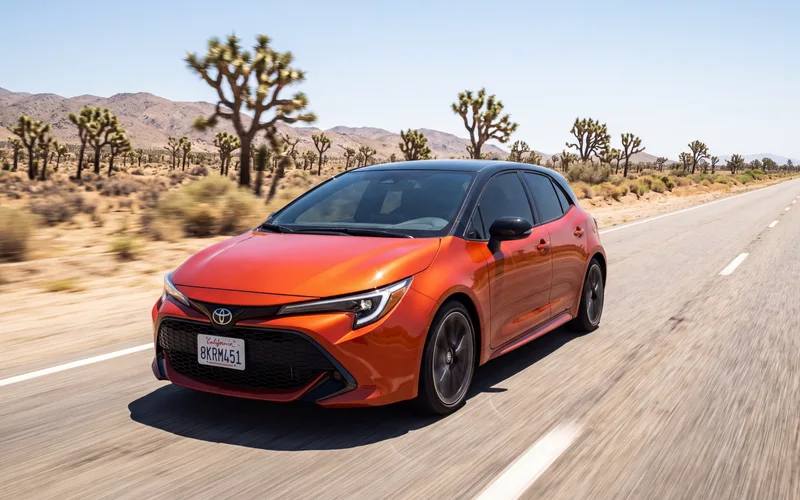 Toyota Corolla HatchbackCompact HatchbackBetter at: Value
Costs less, discounts more freely, and gives you wireless CarPlay on mid trims — worth a look if budget and tech convenience outrank cargo space.
Compare 2.57C+
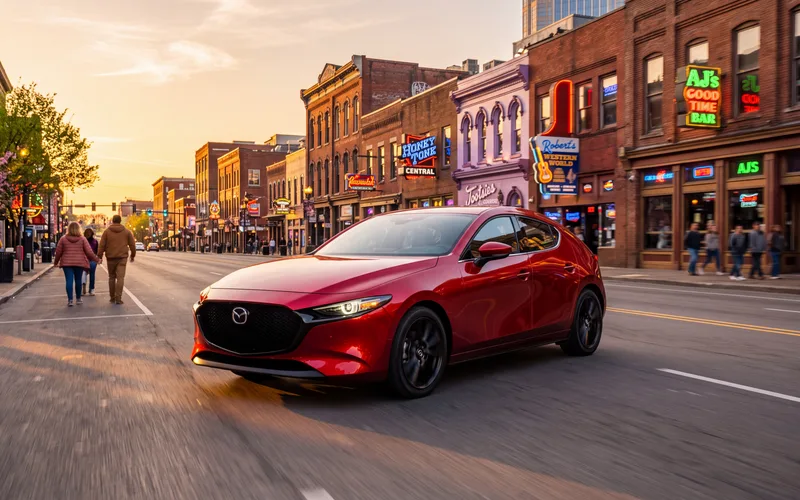 Mazda Mazda3 HatchbackCompact HatchbackBetter at: Interior quality
Offers AWD and a genuinely premium-feeling interior with a head-up display, for buyers who'd trade cargo volume for polish and all-weather traction.
Compare 2.14C
2.14C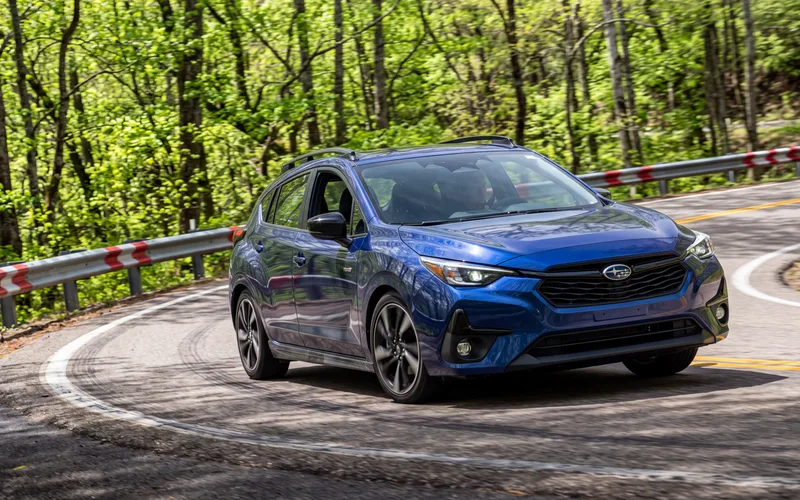 Subaru ImprezaCompact HatchbackBetter at: All-weather traction
Standard all-wheel drive at a lower price makes it the default choice for snow-belt buyers the FWD-only Civic can't serve.
CompareHow it's evolved
10 scored model years · 2017–2026
Subject scores by year
Hover or tap a score to see what moved it versus the year before. A corner mark flags a big swing.
| Year | Performance | Efficiency | Safety | Space | Cost | Reliability | Tech | Use-case | Driving | Value |
|---|---|---|---|---|---|---|---|---|---|---|
| 2026 | 30 | 59 | 76 | 69 | 68 | 80 | 51 | 65 | 72 | 75 |
| 2025 | 25 | 59 | 78 | 65 | 68 | 80 | 48 | 60 | 66 | 72 |
| 2024 | 27 | 54 | 73 | 68 | 69 | 77 | 45 | 55 | 70 | 73 |
| 2023 | 25 | 53 | 77 | 69 | 77 | 79 | 43 | 56 | 68 | 79 |
| 2022 | 25 | 54 | 81 | 69 | 78 | 78 | 43 | 56 | 68 | 80 |
| 2021 | 34 | 46 | 68 | 66 | 72 | 77 | 40 | 53 | 69 | 67 |
| 2020 | 35 | 45 | 69 | 66 | 75 | 74 | 39 | 53 | 70 | 77 |
| 2019 | 34 | 46 | 67 | 65 | 76 | 71 | 30 | 51 | 69 | 75 |
| 2018 | 32 | 60 | 58 | 74 | 76 | 65 | 34 | 58 | 77 | 75 |
| 2017 | 31 | 60 | 63 | 69 | 78 | 64 | 36 | 52 | 69 | 80 |
Compare two years
Best fit & conditions
Higher scores mean a better fit for that use case. Learn more about use-case fit →
Subject profile
Detailed scoring by subject
1Performance & PowertrainThe Civic Hatchback's lowest-graded category.0.02F
The 2017 Civic Hatchback launched the 10th-generation five-door for the US with a single engine, the 1.5-liter turbocharged DOHC direct-injected four; the volume EX/CVT configuration is rated 174 hp @ 6,000 rpm on regular unleaded.
Peak torque of 162 lb-ft is modest in absolute terms but arrives at 1,700 rpm and holds to 5,500 rpm, which is why the car feels stronger than the number suggests.
Published times for the 1.5T scatter by trim and outlet; 7.2 sec is representative of the 174-hp CVT hatchback, between the manufacturer's conservative 7.8-sec claim and the ~6.7–6.9 sec instrumented results recorded for the lighter sedan and the 180-hp Sport Touring.
The small turbo builds boost early and the torque plateau starts at 1,700 rpm, so reviewers report little perceptible lag and strong mid-range response; the engine turns coarse and sounds strained above about 4,000 rpm, which keeps it out of the top band.
The CVT fitted to the volume trims is among the better-calibrated units of its era — it holds ratios sensibly and quiets down at cruise — but still shows the characteristic rubber-band stretch and drone under hard throttle; the 6-speed manual available on LX and Sport is genuinely good and lifts the lineup's ceiling.
The 2017 Civic Hatchback is front-wheel drive only — no all-wheel-drive option exists on any trim, unlike segment rival Subaru Impreza, which makes AWD standard.
One engine — the 1.5-liter turbo — in two states of tune (174 hp on regular, 180 hp with premium), offered with a CVT on every trim and a 6-speed manual on LX and Sport. No hybrid, plug-in or naturally aspirated alternative was available in the hatchback body for 2017; the Civic Hybrid had ended after 2015 and did not return until much later.
2Efficiency & RangeMid-pack among this car's ten categories.2.06C
The volume EX with the CVT is EPA-rated 34 MPG combined on regular unleaded — near the top of the 2017 gas compact class without a hybrid system.
31 MPG city for a non-hybrid compact reflects the small displacement, direct injection and the CVT's ability to keep the engine near its efficiency sweet spot in stop-and-go use.
40 MPG highway is the standout figure of the powertrain and the best number in the hatchback lineup; the Sport trims' wider wheels and center-exit exhaust drop it to 36.
Strong economy is offset by a small 12.39-gallon tank, so total range is good rather than exceptional — about 422 miles combined, and roughly 495 miles at the highway rating.
At EPA's standard 15,000-mile assumption the 34-MPG combined rating on regular fuel puts annual energy cost well below the compact-class average, and only a hybrid or an EV materially beats it.
The volume LX, EX and EX-L Navi trims are designed to run on regular unleaded with no penalty, which is the cheapest and most flexible arrangement available. Only the Sport and Sport Touring carry a premium recommendation — recommended, not required — to reach their 180-hp rating, so the lineup falls just short of a clean sweep.
3SafetyMid-pack among this car's ten categories.2.25C
The 2017 Civic Hatchback, new to the US that year, earned NHTSA's maximum 5-Star Overall Vehicle Score, matching the sedan and coupe bodystyles.
The hatchback earned a 2017 Top Safety Pick when fitted with the optional front crash prevention, with Good results in all five crashworthiness tests IIHS ran. Poor headlights on every configuration blocked the TSP+ award.
Honda Sensing was standard only on the range-topping Sport Touring and merely optional on the volume LX, EX and EX-L Navi CVT cars — the Sport trim could not be ordered with it at all. No blind-spot monitoring or rear cross-traffic alert existed anywhere in the range; EX and above substituted the passenger-side LaneWatch camera.
The optional Collision Mitigation Braking System earned IIHS Superior vehicle-to-vehicle front crash prevention, though it only nearly avoided the 12 mph impact rather than stopping clean. Pedestrian detection — day or night — was not part of the system or the period test protocol, which caps it below the top band.
The only blind-zone aid was LaneWatch on EX and above — a passenger-side mirror camera triggered by the turn signal, which leaves the driver's side entirely uncovered and is not an always-on warning system. Rear cross-traffic alert, rear automatic braking and safe-exit alert were not offered on any trim.
Honda Sensing supplied lane-departure warning, LKAS lane-keeping steering assistance and road-departure mitigation, giving genuine mild centering on well-marked highways. It is a hands-on, low-torque system that wanders between corrections rather than true modern lane centering, and it is absent from the Sport trim entirely.
Adaptive Cruise Control with Low-Speed Follow works to a stop and pairs with LKAS for competent basic highway assist, but the driver must tap the throttle to resume after a full stop, and it is unavailable on the 6-speed-manual Sport and optional on every trim below Sport Touring.
No hands-free highway driving system was offered on the 2017 Civic Hatchback; LKAS explicitly requires the driver's hands on the wheel and disengages otherwise.
IIHS rated all three hatchback headlight configurations Poor — the base halogen projectors, the halogen projectors with high-beam assist, and even the Sport Touring's LED reflectors. The availability of auto high-beam on the upper configurations, a Civic first, is the only thing separating it from the sedan's uniformly assist-free Poor systems.
Rearward-set A-pillars and a low cowl give an excellent forward view, and the multi-angle rearview camera is standard on every trim. The hatchback's upright rear glass is larger than the sedan's fastback opening but is crossed by the tailgate spoiler that hides the wiper and third brake light, and the thick C-pillars leave real over-the-shoulder blind zones that only passenger-side LaneWatch partly offsets.
IIHS rates LATCH ease of use Acceptable: two outboard positions carry complete hardware and the center adds a tether anchor, but the lower anchors sit too deep in the seat bight. Two child seats fit comfortably in the Cars.com check and the hatchback's extra cargo volume helps a family, but three-across is not realistic in a compact.
4Space & ComfortOne of the Civic Hatchback's strongest categories.2.70B-
All five 2017 Civic Hatchback trims seat five, the top of the 4–5 seat hatchback band, and the middle rear position is a proper belted seat with its own head restraint and a tether anchor rather than a token perch. At 55.0 inches of rear shoulder room a third adult back there is still a short-trip proposition.
Honda publishes the moonroof-free figure separately, so per the item definition the value is 39.3 inches — near the top of the 36–40 inch hatchback band and a real dividend of this generation's low cowl and low hip point. Worth flagging for the volume EX buyer: the moonroof is standard from EX up and costs 1.7 inches of it, dropping cabin volume from 97.2 to 94.8 cubic feet.
42.3 inches is squarely mid-band in the 40–44 inch hatchback range and unremarkable on paper, but the packaging flatters it — the pedals sit well forward on a 106.3-inch wheelbase and the seat travel is long, so six-footers are not short of room in a 177.9-inch car.
37.4 inches sits mid-band in the 35–39 inch hatchback range and is one of the quiet wins of the liftback body: Honda raised the roofline behind the B-pillars relative to the sedan's fastback, so second-row headroom does not taper away, and unlike the front measurement the figure is the same whether or not the car has a moonroof.
36.0 inches lands low in the 32–42 inch hatchback band — adequate for a compact but 1.4 inches short of the Civic Sedan built on an identical wheelbase, because the five-door's bench sits slightly further forward to buy cargo length. Two adults ride fine behind two adults; the deficit shows up on the third passenger and on rear-facing child seats.
This is the whole argument for the body style and it scores near the top of the 8–28 cu ft hatchback band. The volume EX's 25.7 cubic feet is roughly 70% more than the 2017 Civic Sedan's 15.1-cu-ft trunk, and the wide, low tailgate aperture means the volume is usable rather than merely measured. The Sport trims give back 3.1 cubic feet to their different rear packaging.
The tenth-generation console is one of the better small-item solutions in any compact: the electric parking brake frees the tunnel for a 7.2-litre bin under a sliding padded armrest, a full-length sliding tray inside it, a two-tier smartphone shelf with wire management, and cupholders that take 42-ounce cups. The cargo bay adds a genuinely clever reversible side-pull tonneau that does not eat load space when the seats fold, four tie-downs and an underfloor spare well. It stays out of the top band because there is no onboard AC power, a single 12-volt outlet, and no rear-seat charging of any kind on the volume EX.
Comfortable rather than outstanding, and the volume trim is where it is held back: the EX's driver's seat is manual with height adjustment only — the 8-way power seat starts at EX-L Navi — and Consumer Reports singles out the absence of lumbar adjustment and a short bottom cushion on this platform. Reviewers who did get the power seat praise its range and the seats' long-distance support, which is the upgrade the mid-trim buyer does not receive.
The multi-link rear axle and fluid-filled bushings give this generation unusually good body control for a compact, and Consumer Reports called the ride 'unusually compliant' and composed over all but the worst bumps. The volume EX is the right trim for it, riding on 215/50R17 all-seasons and — unlike the LX — adding rear fluid-filled bushings as well as front. It falls short of the top band because it is still a firm, short-wheelbase small car that reports texture the segment's most absorbent rivals filter out.
Honda threw an unusual amount of engineering at this — an acoustic windshield, Thinsulate in the doors and roof, triple-sealed door openings, pillar separators, and fiber underbody covers plus felt fender liners specific to EX and above — and reviewers agreed it was a step change from earlier Hondas. It still only reaches mid-band: owners and Consumer Reports report elevated road noise on coarse surfaces, the liftback leaves the cargo bay open to the cabin with no trunk bulkhead, and Honda's decision to add further floor, trunk and fender insulation to the 2020 car is itself evidence that the original package was not where it needed to be.
The volume EX is well equipped for a 2017 compact: dual-zone automatic climate control, heated front seats, heated side mirrors, key-fob remote engine start, Walk Away Door Lock and rear-seat heater ducts all standard. It lands mid-band rather than higher because the comfort list simply stops there — no heated steering wheel and no ventilated seats are offered on any 2017 Civic Hatchback at any price, there are no second-row climate vents (ducts only), and heated rear outboard seats are a Sport Touring exclusive.
5Cost of OwnershipOne of the Civic Hatchback's strongest categories.3.32B+
The entry 2017 Civic Hatchback was the LX with a six-speed manual at $19,700 before destination; with the $835 destination charge in force at the hatchback's fall-2016 launch that is $20,535 delivered, well below the hatchback normalization floor. Honda's destination charge rose to $875 later in the model year, taking the same car to $20,575.
The EX with the CVT is the representative mainstream configuration and the same one this vehicle-year's performance and efficiency scoring describes, at $22,800 plus destination. The Sport CVT sits $700 below it at about $22,935 and is the most numerous 2017 hatchback trim in used inventory, so the two bracket the real transaction band closely.
Civic Hatchback upkeep projections are among the lowest in any segment, and the 1.5-liter turbo's schedule is conventional (no timing belt, Maintenance Minder-driven service). The figure is a model-level projection rather than an archived 2017-specific table, but exact-year annual data corroborates the magnitude.
Residual estimates for the Civic Hatchback bracket this figure from both sides: iSeeCars' observed market data puts it at the top of all hatchbacks, while CarEdge's model is more conservative because it assumes a $30,108 new price that skews toward Sport Touring and Si configurations far above this car's $23,635. 72% is taken as the defensible middle, and either end of the range still clears the hatchback band.
Honda's new-vehicle limited warranty was the conventional three-year term across the 2017 line, including the UK-built hatchback. That sits at the bottom of the scoring band and trails the five-year coverage some mainstream rivals offered.
The five-year powertrain term matches the mainstream industry baseline but sits at the bottom of the scoring band. Every 2017 US Civic Hatchback used the 1.5-liter turbocharged gas engine; no hybrid hatchback was offered that year.
Honda offered no complimentary scheduled-maintenance plan on the 2017 Civic, but did include 24-hour roadside assistance for the full three-year/36,000-mile basic-warranty term. That is basic-roadside-only coverage, the lower end of the middle band, and unremarkable next to rivals bundling two years of free service.
$23,635 volume-trim price minus its estimated resale value after 5 years (72% retained, or about $17,017) leaves about $6,618 in depreciation. Add the projected $1,726 in 5-year maintenance and repairs, and owning this vehicle for 5 years costs about $8,344 in total.
6Reliability & QualityMid-pack among this car's ten categories.2.35C+
Sources conflict sharply: J.D. Power gave the 2017 Civic 3.5/5 predicted reliability, but Consumer Reports withheld its Recommended check over below-average reliability for the 2016-2019 generation, citing in-vehicle electronics, A/C and engine complaints. Owner-reported data since bears out the negative read — A/C failure is far and away the top complaint for this model year.
Honda's long-run reputation for durability is genuinely strong, but the 2016-2019 window is the brand's weak patch: newly redesigned models (Civic, CR-V, Odyssey, Clarity) dragged its standing to mid-pack or worse in both major studies. Not a bottom-third brand, not the top-5 name its reputation implies.
Recall count itself is unremarkable — five NHTSA campaigns, most small-population, plus the industry-wide Denso fuel pump action. What pulls this down is the pattern behind the TSBs: Honda issued two separate goodwill warranty extensions for defects on this generation, an A/C condenser leak and 1.5T oil dilution, which is systemic rather than incidental.
The 1.5L L15B7 turbo was new to this generation and is the only engine offered in the 2017 hatchback, and it carries a documented cold-climate failure mode — fuel washing past the rings and diluting the oil — serious enough that Honda extended powertrain coverage and reflashed engine and CVT software. Outside cold-weather short-trip use the engine and Honda's CVT have held up acceptably, so this is a known-flaw powertrain rather than a broadly failing one.
The tenth-generation cabin was a step change for the Civic and reviewers consistently rated its materials at or near the top of the compact class for 2017 — textured soft-touch dash surfaces, solid switchgear and low-rent plastics confined to lower zones.
Assembly quality from the Swindon plant that builds every US-market 2017 hatchback drew praise for solidity and effective sound insulation, but the model year's initial-quality picture is dented by the electronics and accessory complaints that also hurt its reliability standing.
Honda runs roughly a thousand US dealers with near-universal metro and small-market coverage, and service satisfaction sits at or above the mainstream average — a Civic owner is rarely far from a franchised service bay, and the goodwill warranty extensions on this generation were administered through that network.
The Civic is one of the highest-volume nameplates in the US, so OEM and aftermarket parts are abundant and cheap and independent shops know the car well. The one expensive outlier — the A/C condenser at roughly $1,700 — is offset for most owners by Honda's 10-year extended coverage on that exact part.
7Technology & InfotainmentOne of the Civic Hatchback's weakest categories.0.35F
Seven inches was the compact-class baseline in 2017 and is the exact floor of the 7–15.5 inch hatchback band, so it scores zero on measurement even though the panel itself is a decent high-contrast IPS unit. The bigger story is what sits below it: two of the five trims, including the cheapest two, get no touchscreen whatsoever.
This is the low point of the car and the reason Honda rebuilt the system twice before 2020. The Android-based Display Audio launched with no physical volume knob — volume lived on a capacitive slider — plus capacitive shortcut keys and menu structures Consumer Reports called outright frustrating. It is not scored lower because the hardware is legible and responsive enough once learned, and the trims below EX sidestep the problem entirely with conventional knobs and buttons.
Wired Apple CarPlay and Android Auto are standard on the volume EX and above, which is where the mid band starts — but wireless projection is offered on no trim, and neither is any projection at all on the LX and Sport, which have no touchscreen to run it on. Honda further specifies that projection only works through the 1.5-amp front port, not the console USB.
The volume EX has no embedded navigation at all — Honda's Satellite-Linked Navigation with voice recognition, HD Digital Traffic and Song By Voice is reserved for the EX-L Navi and Sport Touring — so the mid-trim buyer's maps come from CarPlay, Android Auto or the HondaLink app over a cable. Voice control on the EX is limited to Bluetooth phone and audio commands rather than a natural-language assistant.
The EX doubles the LX and Sport's speaker count, running a 180-watt eight-speaker system with four 6.7-inch full-range drivers and four door-mounted tweeters — respectable for a 2017 compact and better than the four-speaker base setup. It sits mid-band because there is no branded premium option at all: the 540-watt 12-speaker system with subwoofer is locked to the range-topping Sport Touring and is an in-house Honda unit, not a Bose or Harman upgrade.
Better than the class norm for 2017 on the trim that matters: the EX and above get the full-colour 7-inch Driver Information Interface with a digital speedometer, trip computer, audio and phone readouts, customisable settings and a turbo boost meter, where LX and Sport make do with a smaller Multi-Information Display. It is a large configurable colour panel rather than a true edge-to-edge digital cluster, which keeps it in the middle band.
None. No 2017 Civic Hatchback receives vehicle or infotainment software over the air — Display Audio firmware is a dealer or USB-stick job and navigation map data on the EX-L Navi and Sport Touring is a purchased disc/USB update, not a push. Nothing in this car gains a feature after it leaves the lot.
HondaLink in 2017 is a media-and-services app, not a remote-control app: it brings Aha internet streaming to the Display Audio, HondaLink Assist automatic collision notification when paired with a phone, and dealer service scheduling. There is no remote lock/unlock, no vehicle locator and no remote start from the phone — the EX's remote engine start is a key-fob function, and Honda did not begin offering app-based remote start until later models.
Thin but not the worst of its era: the EX gets a 1.5-amp USB-A smartphone/audio port at the base of the centre stack plus a second 1.0-amp USB-A inside the console, and one 12-volt outlet. Every port is USB-A and front-only — there is no rear-seat charging of any kind, no wireless charging pad on any trim, and no AC household outlet. The two-tier smartphone tray with wire management is the one thoughtful touch.
The strongest technology showing on the volume EX, and unusually complete for a 2017 compact: Smart Entry proximity access, push-button start/stop, Walk Away Door Lock that arms itself when the key moves 6.5 feet away, keyless tailgate release and key-fob remote engine start all come standard. It stops short of the top band only because there is no phone-as-key and none of it reaches the LX or Sport, which still use a conventional key and twist ignition.
A multi-angle rearview camera is standard on every trim and upgrades to dynamic guidelines on the EX, and LaneWatch adds a passenger-side mirror camera with roughly an 80-degree field of view on the Display Audio screen. That is where it stops: there are no front or rear parking sensors on any 2017 Civic Hatchback, no surround-view camera, no automated parking, and LaneWatch covers only the right side, leaving the driver's blind zone unwatched.
No head-up display is offered on the 2017 Civic Hatchback at any trim level or as any option, including the range-topping Sport Touring — Honda fitted no HUD to the Civic anywhere in this generation.
8Use-Case FitOne of the Civic Hatchback's weakest categories.1.49D
The body style does the heavy lifting: a wide, low tailgate opening onto 25.7 cubic feet takes a stroller without the trunk-lip wrestling the Civic Sedan demands, the rear bench splits 60/40, and every trim has lower anchors at both outboard positions plus tether anchors across all three. It is held to the middle band by 36.0 inches of rear legroom — 1.4 inches less than the sedan on the same wheelbase, which a rear-facing seat feels — and by IIHS finding the lower anchors buried too deep in the seat bight to be easy to use.
The crash structure is excellent — five stars overall from NHTSA and IIHS Good results across the board — but the driver-assistance story fails the 'on the trims families actually buy' test badly for 2017. Honda Sensing is a cost option on the volume EX and standard only on the range-topping Sport Touring; the Sport cannot be ordered with it at any price; there is no blind-spot monitoring or rear cross-traffic alert on any trim, only the one-sided LaneWatch camera; and IIHS rated every available headlight configuration Poor.
The cargo hold is the family strength — 25.7 cubic feet means four people's luggage rides inside with every seat occupied, which almost no compact sedan manages. The rear cabin is where it thins out: heater ducts but no second-row climate vents, no rear USB or 12-volt outlet, no seatback entertainment, a rear centre armrest but heated rear seats only on the Sport Touring, and 36.0 inches of legroom that becomes the limiting factor on hour four rather than hour one.
This is what the car is best at. The 1.5-litre turbo makes its full 162 lb-ft from 1,700 rpm so commuting speeds never require revs, the CVT is one of the better-calibrated units of its era, the electric parking brake includes Automatic Brake Hold on every trim for stop-and-go traffic, and the low cowl and thin A-pillars give one of the clearest forward views in the class. The deductions are the pause off the line while boost builds and the CVT's whine when it does have to work.
Cheap per mile and, unlike the Sport trims, with no fuel-grade asterisk: the volume EX CVT is EPA-rated 31/40/34 mpg on regular unleaded, about $1,850 a year at EPA's 15,000-mile assumption, and it wears inexpensive 215/50R17 all-seasons rather than the Sport's low-profile 235/40R18s. Only a hybrid or an EV materially beats it, which is what keeps it out of the top band.
An urban-friendly footprint at 177.9 inches long and 70.8 wide — about seven inches shorter than the Civic Sedan — and the volume EX gets the good turning circle: 35.7 feet curb-to-curb on its 17-inch wheels, where the 18-inch Sport trims need 37.8. A multi-angle camera with dynamic guidelines and the LaneWatch side view help further. Against it: no parking sensors on any trim, and the liftback's thick rear pillars and spoiler-split rear glass genuinely obstruct the over-the-shoulder view.
Not meaningfully work-capable and not intended to be. Honda publishes no US towing rating for the Civic Hatchback in any configuration, so a trailer is off the table outright; there is no bed, no payload figure worth quoting on a 2,950-lb unibody compact, and the 1.5-litre turbo's 162 lb-ft is calibrated for economy rather than sustained load. What it does have is 25.7 cubic feet of enclosed, lockable space, which covers light courier and sample-carrying duty and is why this is not scored at the floor.
Honda's compact-car durability reputation is real and the unibody is heavily reinforced, but almost none of that reputation had been earned by this specific hardware in 2017: the 1.5-litre turbo and the hatchback body were both first-year items in the US, the engine later drew widespread fuel-in-oil dilution complaints in cold climates, and the interior is cloth and soft-touch plastic with no wear-friendly or washable trim option. Nothing here is built to be abused.
Essentially nothing. Four cargo tie-down anchors and a single 12-volt front outlet are the entire work-oriented provision — no AC inverter or onboard power, no factory roof rails or crossbar attachment points (the roof is bare, so racks are aftermarket clamp-on systems), no factory hitch, no bed or bed access hardware, and carpeted surfaces throughout the cargo area rather than anything washable.
About 420 miles of combined range from a small 12.39-gallon tank (nearly 500 at the highway rating) and a ride Consumer Reports called unusually compliant make it a competent tourer, and the cargo bay means the luggage does not have to be rationed. Three things cap it mid-band: adaptive cruise and lane keeping are a cost option on the EX rather than standard, so the fatigue-reducing hardware is not a given; the EX's manual seat has no lumbar adjustment and a short cushion; and road noise on coarse surfaces is the complaint that recurs most in owner reports.
Pavement-bound by design. Every 2017 Civic Hatchback is front-wheel drive — no AWD is offered on any trim, unlike the segment's Subaru Impreza — with a low-slung body that Consumer Reports notes you fall into rather than step up to, all-season tyres on the volume EX's 17-inch wheels, no tow rating for a bike or boat trailer, no roof rails for a box or a kayak from the factory, and no onboard AC power for camping. Fire roads and a trailhead parking lot are the limit.
The best of the four adventure sub-items and the reason to choose this body over the sedan: 25.7 cubic feet behind the rear seat on the volume EX expands to 46.2 with the 60/40 seatbacks folded onto a flat load floor, through a wide, low tailgate aperture that takes bulky items the sedan's trunk lip refuses. The reversible side-pull tonneau is a genuinely clever touch because its housing does not steal space when the seats are down. Short of the top band only because there are no factory roof rails and no hitch, so anything that will not fit inside has nowhere to go.
9Driving ExperienceMid-pack among this car's ten categories.2.66C+
The independent multi-link rear axle is what separates this Civic from the strut-rear compacts it competes with, and Car and Driver's instrumented test of the 2017 hatchback returned 0.93 g on the skidpad — a hot-hatch figure from a mainstream car. That number came from the Sport on 235/40R18s, so the volume EX on narrower 215/50R17s gives some of it back; what carries over is the chassis, a 25.5 mm tubular front anti-roll bar and reviewers' consistent verdict that it stays flat and composed rather than trading one for the other.
The variable-ratio electric rack is accurate and naturally weighted — reviewers specifically note it tracks straight without the constant small corrections that plague cheap EPS, and it points the car exactly where it is aimed. What it does not do is talk: the weighting is tuned for low-effort parking and there is little road texture coming back through the rim, which is the standard trade in this class and keeps it in the upper-middle band rather than the top.
Genuinely strong for a mainstream compact: Car and Driver stopped the 2017 hatchback from 70 mph in 160 feet, roughly ten to fifteen feet inside the class norm, with four-wheel discs, ABS, EBD and brake assist standard on every trim and a firm, consistent pedal with no regeneration blending to muddy it. Scored a notch below the top band because that figure belongs to the Sport's wider 18-inch rubber and no instrumented result exists for the volume EX on its 215/50R17s, nor any repeated-stop fade data.
The 1.5-litre turbo's torque plateau starts at 1,700 rpm and holds to 5,500, so in normal driving the car is easy to modulate and rarely needs revs, and the CVT is one of the better-calibrated units of its generation. Two things keep it out of the top band: there is a measurable pause off the line while boost builds, and the CVT lets revs flare and hang when asked for full throttle rather than stepping cleanly.
Inoffensive at part throttle and genuinely quiet at a cruise — the engine is smooth and vibration-free where most owners live — but unpleasant when worked. The small turbo four turns coarse and strained above roughly 4,000 rpm, and the CVT's habit of holding high revs under wide-open throttle keeps it there longer than a stepped automatic would. The volume EX at least avoids the Sport's centre-outlet dual exhaust, which adds volume without adding character.
35.7 feet is comfortably in the upper half of the 34–40 ft hatchback band and makes the car easy to place in city parking, helped by a compact 106.3-inch wheelbase and 177.9-inch overall length. It is also a case where the volume trim is the lucky one: choosing the 18-inch Sport instead costs more than two feet of turning circle.
The forward view is a genuine strength — thin A-pillars, a low cowl and deep side glass give one of the clearest sightlines in the class — and the wheel tilts and telescopes on every trim. Three things drag it to the middle: the seating position is low enough that Consumer Reports describes falling into the seat and needing limbo-dance flexibility to get out, the volume EX's driver's seat is manual with no lumbar adjustment, and the liftback's thick rear pillars and spoiler-split rear glass obstruct the over-the-shoulder view the forward one is so good at.
For a mainstream compact this is an entertaining car — sharp turn-in, real grip, a torquey small turbo and a chassis reviewers described as still a great drive and plenty entertaining. What holds the volume trim back is the transmission: the EX is CVT-only, with the six-speed manual restricted to the LX and Sport and the paddle shifters to the Sport and Sport Touring, so the buyer of the trim scored here gets the good chassis without the involving drivetrain, and the engine note gives nothing back.
10Value & Market PositionThe Civic Hatchback's best-graded category.3.43B+
Every hatchback got the 1.5-liter turbo, alloy wheels, automatic climate control, a multi-angle rearview camera, cruise control, Hill Start Assist and 60/40 split-folding rear seats — a stronger base than most compacts, since rivals still sold naturally aspirated base engines. It falls short of the top band because the LX made do with a 5-inch screen, and both Honda Sensing (a $1,000 option) and Apple CarPlay/Android Auto Display Audio required stepping up to EX or paying extra.
A turbocharged 174–180 hp compact with 25.7 cubic feet of cargo space, 33 mpg combined and near-benchmark chassis behaviour for roughly $23,000 delivered was among the segment's strongest content-per-dollar propositions in 2017. It stops short of the very top band because the hatchback carried an $800-plus premium over the equivalent sedan and the cheapest trims lacked the smartphone integration rivals were bundling.
Five hatchback grades — LX, Sport, EX, EX-L Navi and the late-arriving Sport Touring — spread from $20,535 to about $29,135 and spanned economy, comfort, leather-and-navigation and warm-hatch positioning, with a six-speed manual offered on LX, Sport and Sport Touring and the Type R sitting above as a separate halo model. It is short of the top band because every version was front-wheel drive with one engine, and EX and EX-L Navi were CVT-only.
The hatchback launched into the best-selling compact nameplate in America and was well absorbed by the market, but the body style itself is a niche within that segment — Honda targeted roughly 15% of Civic volume, and estimates put first-year US hatchback sales near 45,000 units. That is strong for a compact hatchback without being a segment-wide sales leader in its own right.
Honda is not an aspirational premium badge, but the Civic carried unusually strong loyalty, reliability and resale associations, and the hatchback body reinforced the enthusiast side of the nameplate as the shape that underpinned the Si and the newly announced Type R. That places it above neutral mainstream perception.
A newly launched, UK-imported body style in a nameplate leading its segment left little pressure for factory cash or deep discounting in its first year, so buyer benefit from incentives was minimal beyond ordinary dealer negotiation and occasional promotional financing. The score is deliberately conservative because no archived national incentive schedule for the 2017 Civic Hatchback was retrievable.
This was the first model year of the US Civic Hatchback in this form — the body style returned to America for 2017 after a long absence, on a tenth-generation platform introduced only for 2016 with a brand-new turbocharged engine and cabin architecture. Redesign risk for a 2017 buyer was essentially nil.
The hatchback won its class comparisons rather than merely reviewing well, taking KBB's compact-hatchback test and topping KBB's best-hatchbacks list, on top of the Civic line's overall Best Buy award and an IIHS Top Safety Pick. It is held below the very top band because the marquee enthusiast honours attached to later model years — Car and Driver's 10Best went to the hatchback for 2018 — and because reviewers consistently criticised the knob-free infotainment.